
Should You Hire a Tax Relief Company for Wage Garnishment?
Blog post description.
3/15/202610 min read
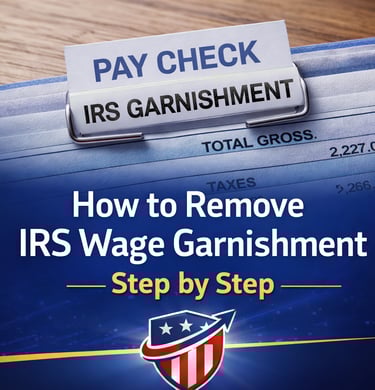
Should You Hire a Tax Relief Company for Wage Garnishment?
If you are reading this, you are likely already under pressure. You may have received one or more IRS notices. You may have heard words like levy or garnishment and felt your stomach drop. You may be watching your bank balance closely or worrying about a call from payroll at work. In many cases we see, taxpayers do not arrive at this question calmly. They arrive here after weeks or months of stress, confusion, and fear about what the IRS can actually do.
This article is written for that exact situation.
Not as a sales pitch.
Not as theory.
Not as a simplified checklist that ignores how IRS enforcement actually unfolds.
It is written from the perspective of someone who has watched many real IRS collection cases move from the first notice to wage garnishment or levy, and who has seen what works, what fails, and what makes things worse.
Before we answer whether hiring a tax relief company makes sense, we need to walk carefully through how IRS wage garnishment actually works, how it differs from levies, and how timing, behavior, and choices affect outcomes more than most taxpayers realize.
https://removeirswagegarnishmentusa.com/remove-irs-wage-garnishment-step-by-step
Understanding IRS Wage Garnishment vs IRS Levy (The Difference Most Taxpayers Miss)
Most taxpayers use the words garnishment and levy interchangeably. In practice, the IRS treats them as very different enforcement tools, with different triggers, timelines, and consequences.
One pattern that repeats across IRS enforcement actions is that confusion about these terms leads people to respond incorrectly, too late, or in ways that escalate the situation.
What the IRS Means by Wage Garnishment
When the IRS garnishes wages, it issues a wage levy to your employer. This is not a court order in the way state garnishments often are. The IRS has administrative authority to do this without going to court.
Once your employer receives the levy:
They are legally required to comply
They must withhold a large portion of your paycheck
The garnishment continues every pay period until the IRS releases it
Unlike many state garnishments, IRS wage garnishment does not have a simple percentage cap. The IRS allows you only a basic exemption based on filing status and dependents. In many real cases we see, this leaves taxpayers with far less take-home pay than they expected.
Wage garnishment is persistent. It does not drain a single paycheck. It slowly suffocates cash flow.
What the IRS Means by a Levy (Especially Bank Levies)
A levy is broader. It is the IRS seizing property or rights to property.
The most common levy we see early is a bank levy. This is where misunderstandings are especially dangerous.
When the IRS levies a bank account:
The bank freezes the account immediately
Funds on deposit are locked for 21 days
After 21 days, the frozen amount is sent to the IRS
In practice, this often happens without warning beyond the required notices that many taxpayers ignored or misunderstood.
Unlike wage garnishment, a bank levy is usually a one-time event—but it can be repeated. And the cash flow shock is immediate.
Why This Distinction Matters More Than You Think
Most taxpayers misunderstand this point:
Stopping a wage garnishment and stopping a bank levy often require different strategies.
What works for one can fail for the other.
Timing, communication, and the type of IRS department handling your case matter enormously. Treating them as the same problem is one of the most common and costly mistakes we see.
How IRS Enforcement Actually Escalates (Not How People Think It Does)
In theory, IRS collections follow a linear path. In practice, enforcement escalates in uneven, sometimes abrupt steps that catch taxpayers off guard.
The IRS Notice Timeline That Leads to Garnishment and Levy
Before any levy action, the IRS is required to send notices. But “required” does not mean “clearly understood.”
In many cases we see, taxpayers receive:
A CP14 or similar initial balance due notice
Follow-up notices increasing in urgency
A Final Notice of Intent to Levy and Notice of Your Right to a Hearing
That final notice is critical. It triggers a short window—usually 30 days—during which certain actions can legally stop levy activity.
Most taxpayers misunderstand this window. Some assume responding later is fine. Others assume calling is enough. Many assume hiring help at any point produces the same result.
It does not.
Why Levies Escalate Faster Than People Expect
One pattern that repeats across IRS collection departments is speed once a case is assigned for enforcement.
Once your account is marked as eligible for levy:
Automated systems move faster
Human discretion decreases
Enforcement actions stack
In practice, this often happens when taxpayers stop responding entirely or respond inconsistently. Silence is interpreted as non-cooperation, not confusion.
Wage garnishment may feel slower, but it is often preceded or followed by bank levies if the IRS believes garnishment alone is insufficient.
Psychological Pressure vs Legal Reality
The IRS does not need to threaten you emotionally. The structure of enforcement does that automatically.
How Fear Drives Bad Decisions
Many taxpayers react emotionally:
They drain bank accounts preemptively
They quit jobs to avoid garnishment
They ignore notices hoping the problem fades
They hire the first tax relief company that promises “immediate relief”
In practice, these reactions often worsen outcomes.
For example, quitting a job does not stop IRS collections. It removes wage garnishment—but often accelerates bank levies and asset seizures.
What the IRS Is Actually Looking For
Contrary to popular belief, the IRS is not primarily trying to punish. It is trying to:
Secure compliance
Establish payment flow
Close cases efficiently
Most IRS agents are not evaluating your stress level. They are evaluating whether you are engaging in good faith.
This is where strategy matters more than desperation.
What We See Most Often in Real IRS Enforcement Cases
In many cases we see, wage garnishment is not the first aggressive action—it is the first visible one.
Pattern 1: The Silent Build-Up
Taxpayers receive multiple notices but delay action because:
They cannot pay
They feel overwhelmed
They assume calling will make things worse
By the time garnishment starts, the IRS has already classified the account as high-risk for nonpayment.
Pattern 2: Late Intervention
Another common pattern is waiting until:
Garnishment is active
A bank account is frozen
Payroll has already been notified
At this stage, options still exist—but fewer of them, and they require precision.
Pattern 3: Mismatched Solutions
We frequently see taxpayers pursue solutions that do not match their enforcement stage.
For example:
Filing paperwork that takes months when garnishment requires immediate suspension
Arguing liability when collections is the active issue
Submitting incomplete financials that trigger deeper scrutiny
The IRS responds poorly to misaligned actions.
How Employers and Banks Are Involved (And Why That Changes Everything)
Once third parties are involved, your leverage changes.
Employers Under IRS Wage Garnishment
Employers are not neutral allies. Once they receive a levy:
They must comply or face penalties
They cannot negotiate on your behalf
They may limit internal flexibility
In practice, this often creates workplace stress, embarrassment, and fear of job loss—even though termination for IRS garnishment is illegal in many contexts.
https://removeirswagegarnishmentusa.com/remove-irs-wage-garnishment-step-by-step
Banks During a Levy
Banks are even less flexible. Once they receive a levy:
Accounts are frozen automatically
Customer service cannot override it
Funds are held pending IRS instructions
Most taxpayers misunderstand this point:
Calling the bank does not stop an IRS levy. Only the IRS can release it.
What Actually Stops Wage Garnishment vs What Stops a Levy
This is where clarity matters.
Actions That Can Stop IRS Wage Garnishment
Depending on timing and circumstances, options may include:
Entering a qualifying installment agreement
Establishing currently not collectible (CNC) status
Filing a timely collection due process (CDP) request
Demonstrating financial hardship
However, not all options work once garnishment is active, and not all suspend collections immediately.
Actions That Can Stop or Reverse a Bank Levy
Bank levies are more time-sensitive. In many cases we see, success depends on:
Acting within the 21-day holding period
Proving immediate hardship
Correctly framing the request to the right IRS unit
Generic paperwork often fails here.
Common Mistakes Taxpayers Make
Most taxpayers do not fail because they owe money. They fail because they act at the wrong time, in the wrong way, or with the wrong expectations.
Mistake 1: Waiting for “One More Notice”
By the time garnishment starts, the IRS believes it already gave enough chances.
Mistake 2: Assuming All Tax Relief Companies Do the Same Thing
Some companies focus on sales. Some delay action. Some submit inappropriate filings that escalate enforcement.
Hiring help without understanding what stage your case is in is risky.
Mistake 3: Confusing Paperwork With Protection
Paperwork does not stop enforcement unless it triggers a legal suspension. Many filings do not.
Patterns That Repeat Across IRS Collection Departments
After observing many cases, certain patterns are consistent regardless of location or balance size.
Pattern A: Speed Increases After Non-Response
The less you respond, the less flexibility you are given.
Pattern B: Timing Beats Perfection
A simple, timely action often outperforms a perfect but late strategy.
Pattern C: Collections Is Not Audits
Arguing fairness or accuracy often fails during active collections unless framed correctly.
So… Should You Hire a Tax Relief Company for Wage Garnishment?
The honest answer is: sometimes—but not automatically.
In many cases we see, hiring help works when:
The taxpayer understands their enforcement stage
The strategy matches the specific action (garnishment vs levy)
Timing is respected
Expectations are realistic
It fails when taxpayers outsource responsibility without understanding what is being done.
A tax relief company does not create options. It executes them—or misuses them.
When Fighting Back Works vs When It Backfires
Fighting back works when:
You act before enforcement locks in
You choose actions that legally suspend collections
You communicate consistently
It backfires when:
You provoke scrutiny without protection
You submit incomplete or misleading information
You delay while “waiting to see”
Regaining Control Without Guesswork
If you are facing wage garnishment or fear it is coming, clarity matters more than optimism.
That is why structured guidance matters.
A Practical Next Step
If you want a clear, step-by-step explanation of:
How IRS wage garnishment actually starts
What stops it (and what does not)
How to choose actions based on timing
How to avoid mistakes that escalate enforcement
Then consider the eBook:
“How to Remove IRS Wage Garnishment – Step by Step”
This is not a promise of miracles. It is a structured guide designed to help you understand your options, protect your income where possible, and make informed decisions instead of reactive ones.
Clarity reduces fear.
Understanding saves money.
Control starts with knowing what actually works—and when.
And if you are already under pressure, that knowledge matters more than ever.
…and in many real cases we see, the difference between relief and escalation comes down to whether the taxpayer understands that the IRS does not pause just because someone is overwhelmed, but it often does respond when the right action is taken at the right moment, before the system moves into the next enforcement phase and locks in consequences that are far harder to unwind mid-
continue
stream.
Why Timing Matters More Than Paperwork
Most taxpayers assume the IRS responds to what you file. In practice, the IRS responds first to when you act.
This is one of the most misunderstood aspects of wage garnishment and levy cases.
The IRS Is a Deadline-Driven System
Every enforcement action is tied to internal clocks:
Notice response windows
Appeal eligibility cutoffs
Automated levy release thresholds
Case transfer points between departments
In many cases we see, taxpayers submit correct paperwork—but miss the window that gives that paperwork legal power.
Once that window closes, the same form can be meaningless.
The Critical Difference Between “Pending” and “Suspended”
Taxpayers often believe that once something is “under review,” collections stop. That belief causes serious damage.
In practice, only certain actions create a mandatory suspension of collection activity. Others do not.
For example:
A properly filed Collection Due Process (CDP) request within the allowed window suspends levy action
An installment agreement request may or may not suspend garnishment depending on status
General correspondence often does nothing
One pattern that repeats across IRS enforcement actions is that taxpayers confuse processing with protection.
The IRS can process your paperwork while still garnishing your wages.
Why Wage Garnishment Feels “Permanent” Once It Starts
Wage garnishment has a psychological weight that bank levies do not.
A bank levy is sudden and shocking. Wage garnishment is slow and relentless.
The Compounding Effect on Cash Flow
In many cases we see, garnishment does not just reduce income—it destabilizes everything connected to it:
Rent or mortgage payments fall behind
Car payments become risky
Credit cards fill the gap
Stress compounds decision fatigue
Because garnishment repeats every pay period, taxpayers feel trapped. Each paycheck confirms that the IRS is in control.
Why the IRS Likes Wage Garnishment
From the IRS’s perspective, wage garnishment is efficient:
Predictable cash flow
Minimal ongoing work
Employer compliance is high
This is why garnishment often continues unless interrupted by a legally effective action, not just intent.
How IRS Departments Behave Differently During Collections
Another area most taxpayers misunderstand is that “the IRS” is not one entity during collections.
Different departments behave differently, and strategies that work in one stage can fail in another.
Automated Collections vs Human Review
Early-stage collections rely heavily on automation. Later stages involve revenue officers.
In automated collections:
Systems trigger notices and levies
Flexibility is limited
Responses must meet strict criteria
Once a revenue officer is assigned:
Human discretion increases
Documentation matters more
Behavior patterns are evaluated
In many cases we see, taxpayers assume escalation means more danger. Sometimes it means more opportunity—if handled correctly.
Why Consistency Matters
Revenue officers track behavior over time.
One pattern that repeats across IRS collection departments is that inconsistent communication damages credibility.
Examples include:
Promising documents and failing to submit
Submitting partial financials repeatedly
Changing explanations
Once credibility is damaged, relief becomes harder—even if financial hardship is real.
The Role of Financial Hardship (And Its Limits)
Financial hardship is real. The IRS recognizes it—but only within defined parameters.
What the IRS Considers Hardship
Hardship is not stress. It is not inconvenience. It is not lifestyle loss.
The IRS looks for:
Inability to meet basic living expenses
Risk to health or safety
Inability to earn income
In practice, this is evaluated using standardized expense allowances, not personal budgets.
Most taxpayers misunderstand this point and argue hardship emotionally instead of structurally.
When Hardship Can Stop Garnishment
If properly documented and timed, hardship can:
Suspend garnishment
Place accounts in Currently Not Collectible (CNC) status
Trigger levy release
But hardship arguments submitted too late or without proper framing often fail.
Why “Doing Nothing” Is Interpreted as a Choice
Many taxpayers freeze. They wait. They hope enforcement pauses.
From the IRS’s perspective, silence is a decision.
One pattern that repeats across IRS enforcement actions is that inactivity accelerates escalation.
The system is designed to move forward unless legally stopped.
Evaluating Tax Relief Companies Realistically
Now we can return to the core question with clarity.
What Tax Relief Companies Actually Do
A tax relief company does not possess special authority. It can:
Communicate with the IRS on your behalf
Prepare and submit requests
Track deadlines
Frame financial information
The value lies in execution, not access.
When They Add Value
In many cases we see, tax relief companies help when:
The taxpayer is paralyzed by stress
Timing is critical
The case requires sustained follow-through
Emotional decision-making needs to be removed
They add less value when:
The taxpayer expects negotiation miracles
The company delays action
The strategy is mismatched to the enforcement stage
Red Flags We See Repeatedly
Patterns that often precede failure include:
Guarantees of “stopping garnishment fast” without explanation
High upfront fees without strategy clarity
Vague promises of “settlement” regardless of circumstances
The IRS does not respond to marketing language.
How to Decide Without Guessing
A better question than “Should I hire a tax relief company?” is:
What action needs to happen right now to stop or limit enforcement?
If you can answer that question clearly and act on it, outside help may not be necessary.
If you cannot—because stress, complexity, or timing are overwhelming—structured assistance may be useful.
Why Understanding the Process Saves More Than Money
Taxpayers often focus on reducing balances. In enforcement cases, stability matters first.
Stopping wage garnishment restores:
Predictability
Decision-making capacity
Financial breathing room
Without that, even good strategies fail.
A Structured Path Forward
If you are facing IRS wage garnishment, guessing is expensive.
That is why a clear, sequenced explanation matters.
About the Guide
“How to Remove IRS Wage Garnishment – Step by Step” is designed to walk through:
How garnishment actually starts
Which actions stop it at each stage
What mistakes trigger escalation
How timing changes outcomes
It is not a shortcut. It is a map.
The goal is clarity, control, and avoiding unnecessary damage—not hype or false promises.
https://removeirswagegarnishmentusa.com/remove-irs-wage-garnishment-step-by-step
Contact
Here to help you stop wage garnishments.
infoebookusa@aol.com
© 2026. All rights reserved.