
Can IRS Garnish Wages While on a Payment Plan?
Blog post description.
2/14/202616 min read
Can IRS Garnish Wages While on a Payment Plan?
If you are reading this, you are likely dealing with IRS notices, mounting anxiety, and a very real fear that your paycheck—or your bank account—could be taken next. In many cases we see, taxpayers are not trying to avoid their obligations. They are trying to survive financially while figuring out what the IRS is actually allowed to do.
One of the most common questions that comes up in real IRS collection cases is this:
Can the IRS garnish wages while you are on a payment plan?
The short answer is yes—sometimes, and the longer answer is where most of the danger, confusion, and opportunity sits. Most taxpayers misunderstand this point, and that misunderstanding is exactly where enforcement actions accelerate.
This article is written from the perspective of someone who has watched IRS cases move from the first notice to full wage garnishment, bank levies, and employer involvement. Not theory. Not best-case scenarios. What actually happens in practice, across thousands of real enforcement patterns.
We will walk through what stops garnishment, what does not, how payment plans really work inside the IRS, and why timing matters more than almost anything else.
https://removeirswagegarnishmentusa.com/remove-irs-wage-garnishment-step-by-step
Understanding IRS Wage Garnishment vs. IRS Levy
Before you can understand whether wages can be garnished during a payment plan, you must understand the legal and operational difference between garnishment and levy. These words are often used interchangeably by taxpayers, but inside the IRS they are very different tools with very different triggers.
What IRS Wage Garnishment Actually Is
IRS wage garnishment is a form of continuous levy on your wages. Once it starts, it does not stop automatically after one paycheck. It continues pay period after pay period until one of the following happens:
The tax debt is fully paid
The levy is formally released
The IRS is legally required to stop
In practice, this often happens when a taxpayer ignores earlier notices or assumes that partial payments alone are enough to prevent enforcement.
Unlike many private creditors, the IRS does not need a court judgment to garnish wages. The authority comes directly from federal law, and once the process is triggered, your employer is legally required to comply.
What an IRS Levy Is (and Why It’s Different)
An IRS levy is the legal seizure of property to satisfy a tax debt. Wage garnishment is one type of levy, but not the only one.
Other common levies include:
Bank account levies
Seizure of accounts receivable (for self-employed taxpayers)
Social Security benefit levies
Vendor payment levies
One pattern that repeats across IRS enforcement actions is that bank levies often happen first, because they are faster, quieter, and more disruptive.
A bank levy usually freezes funds for 21 days before the IRS takes them. A wage garnishment, once active, continues indefinitely.
How Garnishment vs. Levy Affects Cash Flow Differently
This distinction matters because the cash-flow impact is very different.
Bank levy: Sudden, severe, often wipes out rent or emergency funds
Wage garnishment: Ongoing reduction of income, long-term pressure
In many cases we see, taxpayers survive the first bank levy but collapse financially once wage garnishment starts. The paycheck reduction compounds every month.
Can the IRS Garnish Wages While You Are on a Payment Plan?
This is where theory and reality split.
The General Rule (and Why It’s Misleading)
In general, the IRS should not garnish wages if you are in good standing on an approved payment plan. This is what many people hear, and where they stop listening.
But “in good standing” has a very specific meaning inside the IRS—and it is not the same as “I sent some money” or “I filled out a form.”
When the IRS Can Garnish Wages Despite a Payment Plan
In practice, wage garnishment can still happen if:
The payment plan was never fully approved
The plan was approved but defaulted
The plan was approved but other compliance issues exist
The levy process began before the plan was finalized
The plan does not legally block enforcement (certain plan types)
Most taxpayers misunderstand this point. The IRS does not care what you intended to do. It cares what status your account shows on the day the levy is issued.
Timing Is More Important Than Paperwork
One pattern that repeats across IRS collection departments is that enforcement actions often move faster than taxpayers expect, especially once a case is assigned to Automated Collection System (ACS) or a Revenue Officer.
If a levy is already queued in the system, setting up a payment plan after the fact may not stop it in time.
IRS Notice Timeline That Leads to Wage Garnishment
To understand why garnishment happens “unexpectedly,” you need to understand the notice sequence.
Early Notices: The Warning Phase
Most cases begin with:
CP14 – balance due notice
CP501 / CP503 – follow-ups
At this stage, there is no levy threat yet. Many taxpayers ignore these because life is busy and the amounts feel overwhelming.
CP504: The First Serious Escalation
The CP504 notice is where we see many cases start to go wrong.
This notice warns of intent to levy, often referencing state tax refunds. Many people assume this is limited to refunds. It is not.
LT11 or Letter 1058: The Levy Trigger
This is the critical notice: Final Notice of Intent to Levy and Notice of Your Right to a Hearing.
Once this is issued, the IRS has legal authority to levy after 30 days.
In practice, this often happens when taxpayers believe they are “working on” a payment plan but have not completed the process correctly.
What We See Most Often in Real IRS Enforcement Cases
In many cases we see, wage garnishment does not come out of nowhere. It follows a predictable pattern of delay, misunderstanding, and missed timing.
Case Pattern #1: “I Thought the Payment Plan Was Active”
A taxpayer submits an installment agreement request online or by mail. They assume that submission equals protection.
In practice, the IRS may still show the account as collectible until the plan is fully processed. During this gap, levies can and do occur.
Case Pattern #2: Partial Payments Without Formal Agreement
Some taxpayers send money every month without an approved plan. They believe this shows good faith.
One pattern that repeats across IRS enforcement actions is that good faith without legal status does not stop levies.
Case Pattern #3: Default Without Realizing It
Missing one payment, filing late on a new return, or accruing new debt can default a plan automatically. Many taxpayers do not realize this until wages are already being garnished.
Case Pattern #4: Employer Shock
Wage garnishment often becomes real when the employer receives the levy notice. This creates embarrassment, fear, and urgency—exactly when options are narrower.
How Employers Are Involved in IRS Wage Garnishment
Employers are not optional participants. Once they receive a wage levy, they must comply.
What the Employer Receives
The IRS sends a wage levy notice directly to the employer, instructing them how much to withhold.
The exemption amount is based on filing status and dependents, but it is often far less than people expect.
Why This Creates Psychological Pressure
In practice, this often happens without warning to the employee beyond prior IRS notices. The employer may notify payroll immediately.
One pattern that repeats across IRS enforcement actions is that the emotional impact of employer involvement forces rushed decisions, often the wrong ones.
How Banks Are Involved in IRS Levies
Bank levies work differently, and faster.
The 21-Day Hold Rule
When a bank levy is issued, the bank freezes funds for 21 days before sending them to the IRS.
During this window, action can sometimes stop the transfer—but only if you know exactly what to do.
Why Bank Levies Escalate Faster Than Expected
Banks do not negotiate. They comply. Many taxpayers discover the levy when debit cards stop working.
What Actions STOP IRS Wage Garnishment
This is where clarity matters.
Actions That Can Stop Garnishment
A properly approved installment agreement
Currently Not Collectible (CNC) status
An accepted Offer in Compromise (in some stages)
Levy release due to hardship
Certain appeal rights exercised correctly and on time
Actions That Do Not Automatically Stop Garnishment
Sending partial payments
Submitting incomplete forms
Calling without follow-through
Waiting for callbacks
Assuming online submissions are instant
Most taxpayers misunderstand this point, and the IRS does not correct them proactively.
https://removeirswagegarnishmentusa.com/remove-irs-wage-garnishment-step-by-step
What Actions STOP an IRS Levy (and Which Don’t)
Stopping a levy is not the same as stopping garnishment.
Levy-Specific Stops
Timely Collection Due Process (CDP) hearing requests
Proof of procedural errors
Demonstrated economic hardship
Where Fighting Back Backfires
In practice, fighting without understanding IRS timelines often accelerates enforcement. Missed deadlines remove appeal rights entirely.
Common Mistakes Taxpayers Make
This section exists because the same mistakes repeat over and over.
Mistake #1: Waiting for “One More Notice”
By the time the final notice arrives, options are already shrinking.
Mistake #2: Confusing Intent With Status
Intent to pay does not equal protected status.
Mistake #3: Letting Fear Delay Action
Psychological pressure tactics work because fear causes inaction.
Mistake #4: Over-Talking, Under-Acting
Calling repeatedly without submitting the right documents changes nothing.
Patterns That Repeat Across IRS Collection Departments
After watching cases across ACS, field collection, and centralized units, certain patterns repeat.
Pattern #1: Automation Moves Faster Than People
Once a case enters automated enforcement, stopping it requires precision.
Pattern #2: Human Review Is Limited
Many actions are system-triggered, not personally evaluated.
Pattern #3: Timing Beats Argument Quality
A perfect argument submitted late fails. A simple action submitted on time succeeds.
Why Payment Plans Fail to Protect People
Payment plans are not shields. They are tools—and tools must be used correctly.
In practice, many plans fail because:
They were never finalized
They were set too low or too high
They ignored future compliance
They did not address existing levy actions
When Fighting Back Actually Works
Fighting back works when:
You act before levy authority is triggered
You understand which department controls your case
You submit complete, accurate information
You focus on stopping enforcement first, not debating debt
When Fighting Back Makes Things Worse
It backfires when:
Deadlines are missed
Arguments replace action
Assumptions replace confirmation
Emotion drives decisions
The Reality Most Taxpayers Discover Too Late
In many cases we see, wage garnishment could have been prevented—but only if the right steps were taken at the right time.
The IRS does not explain this clearly. It assumes you already know.
A Clear, Structured Way Forward
If your wages are being garnished—or you fear they will be—the most important thing you can do is move from uncertainty to control.
That is why we created the guide:
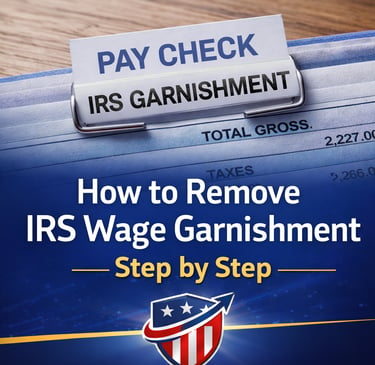
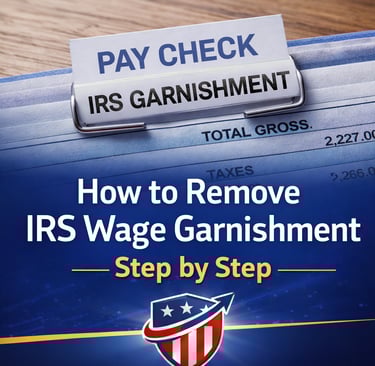
“How to Remove IRS Wage Garnishment – Step by Step.”
This is not a miracle solution. It is a structured roadmap that explains:
Exactly why garnishment started
Which options apply to your situation
What actions actually stop enforcement
How to sequence steps without triggering escalation
How to avoid costly mistakes that prolong garnishment
The goal is clarity, control, and minimizing financial damage—not promises, not hype.
If you need a calm, practical guide that reflects how the IRS actually behaves in real cases, this guide was written for that purpose.
Because when wage garnishment starts, the cost of confusion is paid out of every paycheck—and the sooner you regain control, the more money you keep.
And in many cases, what stops garnishment is not doing more—it is doing the right thing, at the right time, before the system moves again and before the next notice turns into a payroll instruction that no one can undo once it has already been sent to your employer and logged inside the Internal Revenue Service collection system where automated enforcement queues continue to run regardless of phone calls, intentions, or assumptions about what should have happened next, which is why understanding this process fully is often the difference between a temporary problem and a long-term financial crisis that continues paycheck after paycheck until something breaks or until the garnishment is finally addressed using the correct procedural path and not just hope or delay or incomplete action taken after the point where the IRS systems have already moved forward and the next withholding cycle is already scheduled to execute without pause and without waiting for you to feel ready to respond or to fully understand what options were still available before that moment when the levy became active and the window for an easier resolution quietly closed mid-cycle and mid-sentence
continue
…mid-sentence and mid-cycle, which is exactly how most wage garnishments feel to the taxpayer experiencing them.
At that point, many people believe the situation is irreversible. In practice, that belief is one of the most damaging misunderstandings we see.
Wage garnishment can often be stopped or modified, even after it has begun—but only if the response aligns with how the IRS collection system actually operates, not how people assume it operates.
What follows is not theory. It is the reality of what happens after garnishment starts, why some attempts succeed, why others fail, and how timing and sequencing determine the outcome.
What Happens After IRS Wage Garnishment Begins
Once a wage levy is active, the IRS considers the account to be in enforced collection status. This changes how every interaction is handled.
The Account Is No Longer Passive
Before garnishment, your account is usually handled by automated systems that send notices and wait for responses. After garnishment, the system assumes non-compliance or unresolved risk.
In many cases we see, this shift happens silently. Taxpayers keep calling the same numbers, expecting the same flexibility, but the internal posture has already changed.
Payments Alone Do Not Reverse Garnishment
One pattern that repeats across IRS enforcement actions is that taxpayers increase payments once garnishment starts, hoping this will convince the IRS to stop it.
In practice, this often does nothing.
Why? Because once a levy is active, the IRS needs a legal reason to release it—not proof of effort, not hardship stories, not verbal assurances.
Employers Continue Withholding Until a Release Is Issued
Employers are not informed that “talks are happening.” They only act on written IRS instructions.
Even if the IRS verbally agrees to release a garnishment, nothing changes until the employer receives a formal levy release notice.
This delay is why timing matters so much. Each pay period that passes without a release costs you money permanently.
Why Payment Plans Fail After Garnishment Starts
Many taxpayers assume that setting up a payment plan will automatically cancel wage garnishment.
In practice, this is one of the most dangerous assumptions.
Installment Agreements Do Not Always Cancel Existing Levies
Some types of installment agreements prevent new levies but do not automatically release existing ones.
This distinction is rarely explained clearly.
One pattern that repeats across IRS collection departments is this:
The IRS separates the decision to approve a plan from the decision to release enforcement.
Those are two different decisions, often handled by different units.
When a Payment Plan Does Release Garnishment
A garnishment release is more likely when:
The installment agreement is approved and
The agreement amount resolves the collection concern and
There are no default indicators and
The request for release is explicitly made and justified
Most taxpayers never make that final step. They assume approval equals relief.
It does not.
The Psychological Pressure vs. the Legal Reality
The IRS does not threaten garnishment to scare people. It uses garnishment because it works.
But the psychological impact is often greater than the legal one.
Why Garnishment Feels Final (Even When It Isn’t)
It involves your employer
It reduces your income automatically
It feels public and humiliating
It removes your sense of control
In practice, this emotional pressure causes rushed decisions: draining retirement accounts, borrowing at high interest, or agreeing to unaffordable plans.
One pattern that repeats across IRS enforcement actions is that panic decisions cost more than the garnishment itself.
The Legal Reality Is Narrower Than the Fear
Legally, the IRS is limited by:
Collection statutes
Hardship rules
Procedural requirements
Appeal rights
But those protections only apply if used correctly.
Fear causes people to abandon structured responses in favor of quick fixes.
Why Levies Escalate Faster Than Most People Expect
Wage garnishment is often not the first enforcement action—it is the most visible one.
Bank Levies Often Come First
In many cases we see, the IRS tests compliance with a bank levy before moving to wages.
If the bank levy succeeds and no corrective action follows, wage garnishment often comes next.
Silence Is Interpreted as Risk
The IRS does not assume silence means confusion. It assumes silence means unwillingness or inability to resolve the debt.
That assumption drives escalation.
Automated Systems Do Not Wait for Understanding
The IRS collection system does not pause because someone is overwhelmed. It pauses only when the system receives a valid status change.
Which Options Apply to Both Garnishment and Levy—and Which Do Not
Understanding this distinction prevents wasted effort.
Options That Can Affect Both
Currently Not Collectible status
Certain appeal rights (if timely)
Properly structured installment agreements
Hardship-based levy releases
Options That May Stop One but Not the Other
Bank levy releases do not always stop wage garnishment
Installment agreements may block future levies but not release current ones
Appeals filed late may stop nothing at all
Most taxpayers misunderstand this point and pursue the wrong remedy.
Why Timing Matters More Than Documentation
Many people focus on getting paperwork perfect. That matters—but not as much as when it is submitted.
Early Action = More Leverage
Before levy authority is triggered, the IRS is legally restricted.
After levy authority is triggered, discretion narrows.
After garnishment starts, discretion is narrowest of all.
Late Perfection Still Loses
A flawless submission after deadlines expire often changes nothing.
A basic submission on time often changes everything.
The Role of IRS Departments (And Why It Matters)
Different IRS units behave differently.
Automated Collection System (ACS)
Fast, rules-based, limited flexibility. Many garnishments originate here.
Revenue Officers
More discretion, but also more scrutiny. Garnishment here often signals serious risk in the IRS’s view.
Centralized Units
Handle bulk processing. Delays are common. Follow-up is critical.
One pattern that repeats across IRS collection departments is that the same request gets different results depending on where your case sits.
When Removing Garnishment Works Best
Removing garnishment works best when:
The cause is clearly identified
The response matches that cause
The request is framed procedurally, not emotionally
The action is taken before the next payroll cycle
This is not about arguing fairness. It is about triggering the correct system response.
When Trying to Remove Garnishment Fails
It fails when:
The wrong option is pursued
The request lacks legal basis
The timing window has closed
The taxpayer assumes the IRS will “figure it out”
The IRS does not connect dots for you.
The Cost of Doing Nothing
Every pay period under garnishment is money you do not get back.
In many cases we see, taxpayers delay action for weeks, assuming the situation will stabilize. It does not.
The system continues until stopped.
The Value of a Structured, Step-by-Step Approach
Most people do not fail because they lack intelligence or effort. They fail because they do not understand sequence.
Sequence is everything:
Stop enforcement
Stabilize income
Choose the right resolution path
Avoid triggering escalation
Skipping steps creates setbacks.
A Practical Next Step If You Are Facing Garnishment
If your wages are being garnished—or you are on the edge of it—you need clarity more than reassurance.
That is why the guide “How to Remove IRS Wage Garnishment – Step by Step” exists.
It is designed to walk through:
Why garnishment started
What options are realistically available
Which steps stop enforcement vs. delay it
How to avoid mistakes that lock garnishment in place
How to regain control without escalating the case
It does not promise outcomes. It provides structure.
And in IRS enforcement, structure is what separates temporary pressure from long-term damage.
Because once wages are garnished, every missed step costs real money—and the sooner you replace confusion with a clear plan, the sooner you stop losing income to a process that only continues because it has not yet been met with the exact procedural response required to interrupt it before the next automated cycle executes again.
continue
…again, without hesitation and without regard for whether the situation “feels” unresolved to you.
That is the part most people struggle to accept: the IRS collection system does not slow down on its own. It only changes direction when a very specific condition is met, documented, and processed.
What follows goes deeper into how to recognize which condition applies to your case—and how to avoid actions that accidentally make the situation worse.
How to Identify Why Your Wages Are Being Garnished
Before you can stop garnishment, you must understand why it started. This sounds obvious, but in practice, most taxpayers never confirm the root cause.
Garnishment Is a Symptom, Not the Problem
Wage garnishment is not the IRS’s goal. It is a response to one of the following internal conclusions:
The taxpayer is not responding
The taxpayer is responding incorrectly
The taxpayer is responding too late
The taxpayer cannot or will not resolve the balance voluntarily
In many cases we see, the taxpayer focuses entirely on stopping the garnishment without addressing the reason it was triggered. That approach almost always fails.
The Four Most Common Triggers We See
No valid resolution on file
Even if payments were made, the IRS did not see a legally recognized status change.Missed or ignored Final Notice window
The 30-day period after the Final Notice is one of the most important timelines in the entire collection process.Defaulted agreement
Many garnishments occur after an installment agreement default that the taxpayer never noticed.New compliance issue
A missing return or new balance can reactivate enforcement even during an existing plan.
One pattern that repeats across IRS enforcement actions is that taxpayers attempt solutions without confirming which trigger applies. That is why their efforts fail.
Why “Calling the IRS” Often Makes No Difference
Calling feels like action. Sometimes it is. Often it is not.
Phone Calls Do Not Change Account Status
Unless a call results in a documented status update—approved, entered, and processed—the system remains unchanged.
In practice, this often happens:
The taxpayer calls
The agent explains options
The taxpayer feels progress
No enforcement stop is entered
Garnishment continues
This disconnect is one of the most frustrating parts of IRS enforcement.
Verbal Guidance Is Not Protection
One pattern that repeats across IRS collection departments is that verbal guidance is misunderstood as permission or assurance.
It is not.
Only confirmed, logged status changes affect enforcement.
Why Employers Rarely Help (Even When They Want To)
Once an employer receives a wage levy, their role is mechanical.
Employers Cannot Delay or Modify Garnishment
Even sympathetic employers cannot stop or reduce withholding on their own.
If they fail to comply, they become liable for the withheld amounts.
This is why asking payroll to “wait a week” never works.
Why This Feels So Final
The involvement of your employer creates a sense of exposure and loss of privacy. That emotional weight often causes people to act against their own financial interests.
In practice, this is exactly when structured decision-making matters most.
What Actually Causes a Garnishment Release
A garnishment release requires one of a limited number of legal justifications.
Common Valid Reasons for Release
Approved resolution that requires release
Economic hardship properly demonstrated
Procedural error by the IRS
Expired collection statute
Successful appeal (timely and valid)
What Is Not a Valid Reason
Stress
Embarrassment
Partial payment history
Promises to comply
Good intentions
Most taxpayers misunderstand this point. They argue impact instead of cause.
The IRS responds only to cause.
The Difference Between Temporary Relief and Permanent Resolution
Stopping garnishment and resolving the debt are two separate goals.
Temporary Relief
Garnishment release
Levy hold
Short-term status changes
These stop the immediate damage but do not solve the underlying balance.
Permanent Resolution
Installment agreement
Offer in Compromise
Statute expiration
Long-term CNC status
In many cases we see, taxpayers chase permanent resolution first—while garnishment continues in the background.
That sequencing is backwards.
Why Some Payment Plans Trigger More Scrutiny
Not all installment agreements reduce enforcement risk.
High-Risk Payment Plans
Very low monthly amounts without support
Plans submitted after levy authority triggered
Plans that ignore future compliance
Plans that contradict financial data
These plans often delay action briefly, then fail—sometimes with harsher enforcement afterward.
One pattern that repeats across IRS enforcement actions is that weak plans buy time but increase suspicion.
The Role of Hardship (And Why It’s Misunderstood)
Economic hardship can stop garnishment—but only when defined correctly.
IRS Hardship Is Not Emotional Hardship
It is narrowly defined as the inability to meet basic living expenses.
Supporting this requires:
Accurate financial disclosure
Reasonable expense standards
Consistency across documents
In practice, this often works when done correctly—and fails when rushed.
Why Self-Employed Taxpayers Face Faster Escalation
Self-employed income is harder for the IRS to predict.
Why This Increases Enforcement Risk
No employer withholding
Variable income
Higher default rates
As a result, levies on bank accounts and receivables often come faster.
Wage garnishment may appear later—but by then, damage is already done.
How Long Garnishment Can Last If Unaddressed
There is no automatic end date.
Garnishment continues until:
The debt is resolved
The levy is released
The collection statute expires
In many cases we see, garnishment lasts years simply because no one took the correct step to stop it.
The Long-Term Cost of “Waiting It Out”
Some taxpayers hope garnishment will end on its own.
This almost never works.
Why Waiting Costs More
Lost income compounds
Interest continues
Stress affects decision-making
Options narrow over time
The IRS does not lose patience. It enforces until stopped.
Why Clarity Changes Outcomes
Once a taxpayer understands:
Why garnishment started
Which department controls the case
What status stops enforcement
How to sequence actions
Outcomes change dramatically.
Not because the IRS becomes kinder—but because the response finally matches the system.
A Calm, Practical Way to Regain Control
If you are facing wage garnishment—or trying to prevent it—the most valuable shift you can make is from reaction to structure.
That is the purpose of the guide:
“How to Remove IRS Wage Garnishment – Step by Step.”
It exists because most information available is fragmented, theoretical, or incomplete.
The guide focuses on:
Real enforcement patterns
Decision paths that actually work
What to do first, second, and third
How to stop losing money while you decide next steps
It does not promise outcomes. It helps you avoid preventable losses.
Because in real IRS cases, success is rarely about brilliance. It is about timing, accuracy, and understanding which lever actually moves the system before the next payroll run executes again and again and again until someone intervenes correctly and deliberately instead of reacting in pieces or waiting for clarity that never arrives unless you actively create it through informed, structured action that aligns with how IRS enforcement truly operates rather than how most people assume it should operate.
https://removeirswagegarnishmentusa.com/remove-irs-wage-garnishment-step-by-step
Contact
Here to help you stop wage garnishments.
infoebookusa@aol.com
© 2026. All rights reserved.