
IRS Wage Garnishment Notice From Employer: What To Do Immediately
Blog post description.
9/30/202610 min read
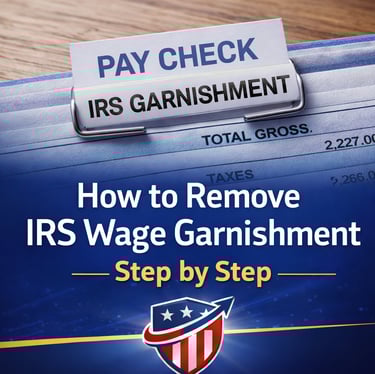
IRS Wage Garnishment Notice From Employer: What To Do Immediately
If your employer has handed you a notice saying the IRS is taking part of your paycheck, you are not overreacting if your first reaction is panic. In real life, this moment is one of the most emotionally intense points in the entire IRS collection process. We have seen taxpayers freeze, quit jobs, ignore payroll departments, or assume the damage is already done. None of those reactions help.
What matters now is understanding exactly what this notice means, what the IRS has already done, and what still can be stopped. An IRS wage garnishment is serious, but it is not the end of the road. In many cases we see, action taken in the first days after the employer notice makes the difference between months of financial suffocation and a controlled resolution.
This article is written for that moment.
Not theory. Not IRS brochure language. Not “talk to a professional” filler. What follows is based on repeated, real-world enforcement patterns—cases that went from first notice to levy, cases that stopped garnishment midstream, and cases where doing the wrong thing at the wrong time made everything worse.
Read carefully. Timing matters more than most people realize.
https://removeirswagegarnishmentusa.com/remove-irs-wage-garnishment-step-by-step
Understanding What an IRS Wage Garnishment Really Is
Before you can decide what to do, you need clarity on what is actually happening. Most taxpayers misunderstand this point, and that misunderstanding alone causes costly mistakes.
IRS Wage Garnishment vs IRS Levy: The Legal Difference
The IRS does not use the word “garnishment” in the same way courts and private creditors do. What people call an IRS wage garnishment is legally a wage levy.
Here is the distinction that matters:
Wage Garnishment (general concept)
A recurring seizure of wages, usually ordered by a court, often limited by state law percentages.IRS Wage Levy (what you are facing)
A federal administrative action that allows the IRS to take wages continuously without court approval and without state-law percentage caps.
This is not semantics. It explains why the IRS has more power than other creditors and why employers comply immediately.
One pattern that repeats across IRS enforcement actions is that taxpayers assume IRS wage garnishment works like credit card garnishment. It does not. State protections do not apply. Federal law controls.
Why IRS Wage Levies Are So Aggressive
An IRS wage levy:
Continues every pay period
Has no automatic end date
Leaves you only a small exempt amount based on filing status and dependents
Can remain in place until the debt is paid, settled, or the levy is released
In practice, this often happens when taxpayers believe the IRS “will stop once they get some money.” That is false. The IRS stops only when there is a legal reason to stop.
What an Employer Wage Garnishment Notice Means
When your employer gives you an IRS notice, several things have already happened behind the scenes.
What the IRS Has Already Done
By the time payroll is notified:
The IRS has assessed the tax
Notices demanding payment have been sent
Your account has been classified as delinquent
Your case has moved into active collections
A Final Notice of Intent to Levy was issued (or legally deemed issued)
In many cases we see, taxpayers swear they “never got the final notice.” Sometimes that is true. Legally, it often does not matter. The IRS only needs to send it to your last known address.
What the Employer Is Required to Do
Your employer is not choosing sides. They are legally required to:
Start withholding wages immediately
Follow IRS exemption tables
Send withheld wages to the IRS
Ignore employee pleas to stop unless the IRS releases the levy
Employers who fail to comply can become personally liable. That is why payroll departments move fast and show little flexibility.
Why Talking to Payroll Alone Does Nothing
One of the most common early mistakes is trying to negotiate with HR or payroll.
They cannot:
Delay the levy
Reduce the amount
Cancel the order
Protect your job beyond internal policy
Only the IRS can release or modify the levy.
How IRS Wage Garnishment Affects Your Cash Flow
Understanding the cash-flow impact helps you make rational decisions instead of panic-driven ones.
How Much the IRS Takes From Each Paycheck
The IRS allows you to keep:
A base exempt amount
Plus a small addition per dependent
Everything above that is taken.
In practice, this often means:
50% to 70% of net pay is seized
Sometimes more for higher earners
Sometimes nearly all disposable income for single filers
Unlike court garnishments, there is no percentage cap.
Why Wage Levies Hurt More Than Bank Levies Over Time
Most taxpayers fear bank levies more. That fear is understandable—but misplaced.
Bank levy: One-time seizure of available funds
Wage levy: Continuous, repeating seizure
A bank levy hurts once. A wage levy suffocates month after month.
One pattern that repeats across IRS collection departments is that wage levies are used specifically to force compliance. The pain is intentional.
IRS Notice Timeline Leading to Wage Garnishment
Most taxpayers underestimate how many chances they had—and how fast things escalate once enforcement begins.
Typical Notice Sequence
In many cases we see, the timeline looks like this:
CP14 – Balance due notice
CP501 / CP503 – Reminder notices
CP504 – Urgent notice, intent to levy (often misunderstood)
LT11 or Letter 1058 – Final Notice of Intent to Levy and Right to a Hearing
Levy action – Bank or wage levy
The biggest misunderstanding: CP504 is not the final notice, but it psychologically pressures people into thinking they are already levied.
Psychological Pressure vs Legal Reality
The IRS uses escalating language intentionally:
“Urgent”
“Immediate action required”
“Final notice”
Most taxpayers misunderstand this point. Some notices sound scarier than they legally are. Others are legally deadly but look similar to earlier letters.
By the time wages are levied, the IRS has crossed from warnings into action.
What We See Most Often in Real IRS Enforcement Cases
This section matters. These are not hypotheticals.
Case Pattern #1: The “I’ll Call Later” Delay
In many cases we see, taxpayers receive the final notice and plan to “call next week.”
That week becomes months.
Once a levy is issued:
Options narrow
Processing slows
The burden shifts to the taxpayer
Reversal becomes harder
Timing matters more than paperwork. Acting before levy issuance is easier than undoing one.
https://removeirswagegarnishmentusa.com/remove-irs-wage-garnishment-step-by-step
Case Pattern #2: Partial Payments That Backfire
Another repeating pattern is sending small payments hoping to “show good faith.”
In practice:
Small payments do not stop levies
They reset internal timelines
They sometimes delay real resolution
They give false reassurance
The IRS wants resolution, not gestures.
Case Pattern #3: Ignoring Employer Notice Out of Shame
Some taxpayers avoid payroll, hoping it “goes away.”
It does not.
Ignoring it:
Does not stop withholding
Does not protect your job
Often increases stress and embarrassment
Employers follow the levy regardless of employee reaction.
Common Mistakes Taxpayers Make
These mistakes cost people months or years of unnecessary financial damage.
Mistake #1: Assuming Garnishment Means It’s Too Late
It is not too late—but it is later than it should be.
In many cases we see, wage levies are released after:
Installment agreements
Certain hardship determinations
Approved resolutions
But delay reduces leverage.
Mistake #2: Filing Forms Without a Strategy
Submitting random forms:
Collection Information Statements
Hardship claims
Partial payments
…without understanding timing and consequences often backfires.
One pattern that repeats across IRS enforcement actions is that poorly timed submissions trigger deeper scrutiny.
Mistake #3: Triggering Bank Levies While Trying to Stop Wage Levies
This happens more than people expect.
Certain actions:
Revealing bank balances
Updating direct deposit information
Moving funds poorly
…can shift enforcement from wages to banks.
Stopping one enforcement channel without awareness of others is dangerous.
IRS Levy vs IRS Wage Garnishment: Why Levies Escalate Faster Than Expected
Many taxpayers believe wage garnishment is the worst-case scenario. Often, it is only a step.
Why the IRS Uses Multiple Levies
The IRS can:
Levy wages
Levy bank accounts
Levy refunds
Levy Social Security
Levy business receivables
In practice, this often happens when wage levies do not produce enough pressure.
Why Bank Levies Often Follow Wage Garnishment
One pattern that repeats across IRS collection departments is stacking enforcement.
If wages alone:
Do not resolve the balance
Do not trigger compliance
Do not lead to agreement
…bank levies frequently follow.
What Actions STOP Wage Garnishment vs STOP Bank Levies
This distinction is critical.
Actions That Can Stop Wage Garnishment
Depending on timing and eligibility:
Approved installment agreements
Certain hardship determinations
Full payment or accepted settlement
Bankruptcy filing (temporary stop)
Not all options apply to all taxpayers.
Actions That Stop Bank Levies but Not Wage Garnishment
Many people misunderstand this point.
Some actions:
Release frozen bank funds
Prevent future bank levies
…but do not automatically release wage levies.
Each levy must be addressed directly.
Patterns That Repeat Across IRS Collection Departments
After watching cases across Automated Collection, Revenue Officers, and specialized units, certain patterns repeat.
Pattern #1: Speed Over Sympathy
IRS systems move faster than human empathy.
Calls may be polite. Systems are not.
Pattern #2: Silence Is Interpreted as Noncompliance
No response equals escalation.
Pattern #3: Action Before Levy Is Easier Than Action After Levy
This cannot be overstated.
Pattern #4: Timing Controls Outcomes More Than Paperwork Quality
Perfect paperwork submitted late loses to imperfect action taken early.
When Fighting Back Works — and When It Backfires
Not every fight is worth starting.
When Fighting Back Works
Before levy issuance
When facts support hardship
When communication is timely
When requests align with IRS authority
When Fighting Back Backfires
After levy without plan
With incomplete information
With emotional arguments
With threats or ultimatums
In practice, this often happens when taxpayers confuse frustration with leverage.
Immediate Steps to Take After Receiving an IRS Wage Garnishment Notice
This is where clarity matters.
Step 1: Confirm What Type of Levy Is Active
Wage levy only? Bank levy pending? Both?
Step 2: Identify Your Last IRS Notice
What was the last letter number? Timing depends on this.
Step 3: Assess Cash Flow Reality
What will your net pay look like next period?
Step 4: Decide on an Action Path — Fast
Delay only helps the IRS.
Why Timing Matters More Than Paperwork
One of the hardest truths for taxpayers to accept is this:
The IRS rewards speed more than perfection.
In many cases we see:
Fast imperfect action stops levies
Slow perfect submissions arrive too late
This is not fair. It is real.
What Comes Next If You Do Nothing
If you ignore the wage garnishment:
It continues indefinitely
Interest and penalties continue
Additional levies may follow
Financial pressure increases
Waiting does not improve leverage.
Regaining Control After IRS Wage Garnishment Starts
Control is not about arguing. It is about positioning.
Control Comes From:
Understanding enforcement mechanics
Acting within IRS rules
Choosing actions that force release
Not from hope.
A Structured Path Forward
At this stage, you need:
Clear sequencing
Understanding of which actions work now
Awareness of traps that make things worse
This is where most taxpayers get lost—because IRS information is fragmented and procedural, not practical.
Final Word — And Your Next Step
If you are dealing with an IRS wage garnishment notice from your employer, you are not powerless—but you are on a clock.
Most taxpayers fail here not because they lack intelligence, but because they lack structure. They react instead of sequence. They file instead of plan. They wait instead of act.
That is why a structured, step-by-step approach matters.
If you want a clear, practical guide that walks through:
How IRS wage garnishment actually works
What stops it and what does not
Which actions apply now, not theoretically
How to avoid triggering worse enforcement
How to regain financial breathing room methodically
…then the eBook “How to Remove IRS Wage Garnishment – Step by Step” was created for this exact situation.
It is not a promise. It is not a miracle solution. It is a structured roadmap based on real enforcement patterns, designed to help you understand your options, act decisively, and regain control without making things worse.
Clarity reduces fear. Structure restores control.
continue
…Structure restores control.
And control is exactly what most taxpayers feel they have lost by the time a wage garnishment notice reaches their employer.
What typically happens next, if there is no clear plan, is not resolution—it is drift. Paychecks shrink. Bills pile up. Stress increases. Decision-making worsens. The IRS, meanwhile, does exactly what it is designed to do: it continues collecting in the most efficient way available to it.
That is why structure matters more than motivation, fear, or even good intentions.
Why Most IRS Information Fails at This Stage
Most IRS resources explain rules, not sequence.
They tell you:
What an installment agreement is
What an Offer in Compromise is
What “currently not collectible” means
What they do not tell you is:
Which option works after a wage levy is active
Which option triggers more scrutiny if chosen too early
Which option looks attractive but silently fails to release garnishment
Which timing windows quietly close once payroll is involved
In many cases we see, taxpayers technically “do the right thing” but in the wrong order, and the result is months of continued garnishment even though a better outcome was available.
Why IRS Wage Garnishment Is a Decision Problem, Not Just a Paperwork Problem
Most taxpayers believe stopping garnishment is about filling out the correct form.
In practice, it is about:
Choosing the correct entry point into the IRS system
Understanding which department currently controls your account
Knowing what actions cause mandatory release versus discretionary review
Avoiding moves that shift your case into slower or harsher channels
One pattern that repeats across IRS enforcement actions is that taxpayers lose time not because the IRS denies them—but because the IRS processes them slowly, while the levy keeps running.
The levy does not pause while paperwork is reviewed.
Why “Just Calling the IRS” Often Makes Things Worse
Calling without a plan feels proactive. Often it is not.
In many cases we see:
Call center agents give technically correct but incomplete guidance
Taxpayers disclose information that changes enforcement posture
Verbal agreements that do not trigger levy release
False reassurance that “something is pending” while garnishment continues
Phone calls do not stop wage levies. Triggered system actions do.
What a Structured Guide Actually Does Differently
A structured guide is not about giving you more options. It is about narrowing your choices to the ones that actually work at this stage.
Specifically, a step-by-step guide helps you:
Identify which IRS authority currently controls your wages
Understand what forces a levy release versus what merely requests one
Sequence actions so that one step unlocks the next
Avoid actions that feel helpful but extend garnishment
Make decisions based on timing, not emotion
Most taxpayers misunderstand this point: the IRS responds more predictably than it appears, once you understand the patterns.
Why This Matters Financially
Every additional pay period under wage garnishment:
Reduces your flexibility
Increases reliance on credit
Increases default risk elsewhere
Increases psychological pressure
In many cases we see, stopping garnishment even one or two pay cycles earlier:
Prevents downstream financial damage
Avoids secondary collection actions
Preserves job stability
Restores basic cash-flow control
This is not about “beating” the IRS. It is about containing damage.
A Clear Path Forward, Without Guesswork
The eBook “How to Remove IRS Wage Garnishment – Step by Step” exists because most people facing wage garnishment do not need motivation or reassurance. They need order.
It lays out, in plain American English:
How the IRS decides to garnish wages
What has already happened by the time your employer is notified
Which actions still work after garnishment starts
Which commonly suggested actions quietly fail
How to approach the IRS in a way that leads to release, not delay
How to regain financial breathing room without triggering new enforcement
There are no guarantees. There are no promises of magic outcomes. There is only structure, clarity, and a realistic path through a stressful situation that many taxpayers have already navigated—successfully—once they understood the mechanics.
If you are under wage garnishment now, confusion is expensive. Clarity is not.
And the sooner you move from reaction to structure, the sooner you begin regaining control of your income instead of watching it disappear one paycheck at a time.
https://removeirswagegarnishmentusa.com/remove-irs-wage-garnishment-step-by-step
Contact
Here to help you stop wage garnishments.
infoebookusa@aol.com
© 2026. All rights reserved.