
IRS Wage Garnishment and Your Employment Rights
Blog post description.
3/10/202613 min read
IRS Wage Garnishment and Your Employment Rights
When people talk about “the IRS taking your paycheck,” they usually mean one of two very different enforcement actions. In real cases we see every week, confusion between these actions causes panic, bad decisions, and missed opportunities to stop damage early.
This article is written for taxpayers who are already under pressure. You may have unopened IRS letters. You may be behind on rent or juggling credit cards. You may be afraid your employer will find out, or that your bank account will be emptied overnight.
What follows is not theory. It reflects patterns that repeat across real IRS enforcement cases, from the first computer-generated notice to the moment a payroll department receives a levy order. The goal is clarity, not comfort. Once you understand how the IRS actually operates, fear tends to drop—and control becomes possible again.
https://removeirswagegarnishmentusa.com/remove-irs-wage-garnishment-step-by-step
IRS Wage Garnishment vs IRS Levy: The Legal Difference That Changes Everything
Most taxpayers—and many employers—use the term “garnishment” loosely. The IRS does not.
What the IRS Means by “Wage Garnishment”
In IRS terminology, wage garnishment is a continuous wage levy. Once it starts, it stays in place until one of a limited number of things happens. It is not a one-time event.
In practice, this means:
Your employer is legally required to withhold a large portion of each paycheck
The withholding continues pay period after pay period
The levy does not expire automatically after a set number of weeks
The IRS does not need to re-issue it every month
In many cases we see, taxpayers assume wage garnishment is temporary. They believe they can “wait it out” or let a few paychecks go by until the IRS moves on. That is almost never how it works.
What the IRS Means by “Levy”
A levy is the legal seizure of property to satisfy a tax debt. Levies come in many forms:
Bank levy
Wage levy
Social Security levy
Vendor or accounts receivable levy
Asset levy (vehicles, equipment, etc.)
A bank levy is typically one-time, not continuous. The IRS freezes the account, waits a short holding period, and then takes what is available up to the levy amount.
This distinction matters because cash flow disruption behaves very differently under each action.
Why the Difference Matters for Cash Flow
One pattern that repeats across IRS enforcement actions is this:
Bank levies cause sudden shock
Wage levies cause long-term suffocation
With a bank levy, the damage is immediate and obvious. With a wage levy, the damage compounds quietly over time. Rent, utilities, childcare, transportation—everything becomes harder, not all at once, but relentlessly.
Most taxpayers misunderstand this point and focus all their fear on bank levies, when wage garnishment is often more destructive long-term.
How IRS Enforcement Actually Escalates (Not How People Think It Does)
The IRS does not move randomly. It follows a rigid escalation ladder, but the timing surprises people.
The Notice Phase: Where Most Opportunities Are Missed
Before any levy, the IRS must send a series of notices. These are not friendly reminders. They are legal steps.
In many cases we see, taxpayers receive:
CP14 or similar initial balance due notice
Follow-up reminders
A Final Notice of Intent to Levy (LT11 or CP90)
Most taxpayers skim these letters or assume they are automated threats with no teeth. That assumption is costly.
In practice, the Final Notice of Intent to Levy is the last meaningful warning before enforcement. After this point, the IRS has legal authority to levy wages or bank accounts.
Why Levies Escalate Faster Than People Expect
One pattern that repeats across IRS collection departments is speed after silence.
If the IRS hears nothing from you after the final notice period expires, enforcement can happen quickly. Not immediately—but unpredictably.
Taxpayers often expect a call, another letter, or a negotiation attempt. Instead, the next communication is sent to your employer or bank.
This is why timing matters more than paperwork. A perfect form submitted too late does nothing. A simple phone call made early can stop enforcement entirely.
What Happens When the IRS Contacts Your Employer
Wage garnishment feels personal because it becomes visible.
The Employer’s Role (and Limits)
When the IRS issues a wage levy, it sends Form 668-W to your employer. At that point:
Your employer has no discretion
They cannot delay
They cannot negotiate on your behalf
They must calculate exempt income using IRS tables
They must send the remainder to the IRS
In many cases we see, employers are uncomfortable but compliant. Payroll departments are trained to treat IRS levies as non-negotiable.
Employment Rights and Misunderstandings
A common fear is termination. Federal law prohibits employers from firing an employee because of one wage levy.
However, this protection is narrower than people think:
It applies to federal levies, not all garnishments
It does not protect against indirect consequences
It does not prevent strained workplace dynamics
Most taxpayers misunderstand this point and assume job security is absolute. It is not. While outright firing may be illegal, reduced hours, missed promotions, or quiet pressure can still occur.
Psychological Pressure vs Legal Reality
The IRS relies heavily on psychological pressure. This is not accidental.
How Pressure Is Applied
In practice, this often happens when:
Notices use urgent language without explaining options
Deadlines are emphasized without context
Consequences are stated without probabilities
The goal is compliance, not education.
What the IRS Can and Cannot Do
Legally, the IRS has broad power. Practically, it operates within constraints:
It prefers voluntary resolution
It avoids unnecessary disputes
It prioritizes efficiency over punishment
Understanding this gap between authority and behavior is critical. Fear pushes people into mistakes. Calm action opens options.
What Stops Wage Garnishment (And What Does Not)
This is where many cases go wrong.
Actions That Stop Garnishment
In real enforcement cases, wage garnishment stops when:
A formal installment agreement is accepted
An offer in compromise is under active consideration
The account is placed in currently not collectible status
The levy is proven to create economic hardship
A timely Collection Due Process hearing is requested
Timing determines which of these are available.
Actions That Do NOT Stop Garnishment
Common but ineffective actions include:
Sending partial payments without agreement
Ignoring employer communications
Filing paperwork after garnishment begins without follow-up
Arguing fairness instead of eligibility
In many cases we see, taxpayers believe effort equals protection. The IRS responds only to actions that fit within its procedural framework.
What Stops a Bank Levy (And Why It’s Different)
Bank levies behave differently.
One-Time Nature, Permanent Consequences
A bank levy usually captures funds once. But the consequences ripple:
Accounts may be closed
Automatic payments fail
Credit damage escalates
Financial instability increases IRS scrutiny
Stopping a bank levy often requires faster action than stopping wage garnishment. Once funds are transferred, recovery is difficult.
https://removeirswagegarnishmentusa.com/remove-irs-wage-garnishment-step-by-step
What We See Most Often in Real IRS Enforcement Cases
This section matters because patterns reveal leverage.
In many cases we see taxpayers who:
Ignore early notices because amounts seem unmanageable
Panic only after enforcement begins
Rush into the wrong resolution path
Miss deadlines by days, not months
One repeating pattern is delay driven by fear. The IRS benefits from silence. Taxpayers benefit from early, imperfect action.
We also see a sharp divide between outcomes for taxpayers who act before enforcement and those who act after. The same debt produces radically different results depending on timing.
Another pattern is misunderstanding IRS departments. Collections, Appeals, and Automated Systems behave differently. Treating the IRS as a single entity leads to missteps.
Common Mistakes Taxpayers Make
The most damaging mistakes are rarely dramatic. They are subtle.
Mistake 1: Waiting for “the right moment”
There is no perfect moment. Waiting usually removes options.
Mistake 2: Over-documenting instead of communicating
Paperwork without engagement often sits untouched while enforcement continues.
Mistake 3: Assuming fairness arguments matter
The IRS operates on eligibility, not sympathy.
Mistake 4: Treating wage garnishment as temporary
This misunderstanding causes long-term financial damage.
Mistake 5: Fighting when cooperation would work better
In some stages, resistance helps. In others, it accelerates enforcement. Knowing the difference is critical.
Patterns That Repeat Across IRS Collection Departments
Different departments, same behaviors.
Silence triggers automation
Engagement pauses enforcement
Missed deadlines eliminate appeal rights
Hardship claims succeed when properly framed
Early action is rewarded disproportionately
Most taxpayers misunderstand this point: the IRS is less adversarial than it appears—but only if you enter the process correctly.
When Fighting Back Works—and When It Backfires
Fighting back works when:
Deadlines are preserved
Appeals are timely
Positions are procedurally valid
It backfires when:
It delays resolution
It signals non-cooperation
It relies on emotion instead of rules
In practice, the strongest position is often calm compliance with strategic resistance, not confrontation.
Why Timing Matters More Than Paperwork
We see cases where minimal documentation filed early stops enforcement entirely, while thick packets filed late do nothing.
Timing determines:
Which departments handle your case
Which rights remain available
Whether enforcement pauses automatically
Paperwork is secondary to sequence.
Your Next Step: Regaining Control Without Guesswork
If you are facing wage garnishment—or believe it may be coming—clarity matters more than speed. Panic leads to costly mistakes. Guessing leads to delays.
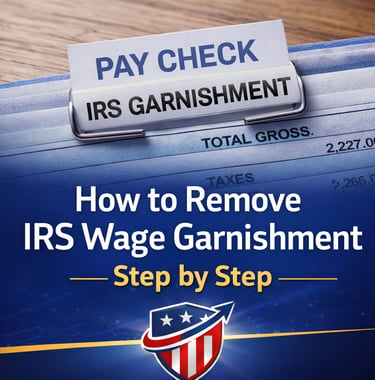
The eBook “How to Remove IRS Wage Garnishment – Step by Step” is designed for taxpayers who want structure, not hype. It walks through real enforcement timelines, explains which actions work at each stage, and shows how to protect income legally and strategically.
It does not promise miracles. It offers something more valuable: a clear path to regain control, reduce financial damage, and make informed decisions instead of reactive ones.
If you need a calm, practical guide that reflects how the IRS actually behaves—not how people hope it behaves—this guide was written for you.
…and once taxpayers understand this sequencing, the most common next question becomes how to decide between an installment agreement and a hardship claim when income fluctuates, because in many real-world cases the line between affordability and impossibility is not clear, and the IRS’s internal calculations often lag behind a taxpayer’s actual financial reality, which is where the risk of choosing the wrong path at the wrong moment can quietly lock someone into years of unnecessary wage withholding if they don’t pause and evaluate the long-term implications before submitting forms that appear harmless on the surface but, in practice, signal to the IRS that the taxpayer accepts a level of payment that is not sustainable, leading to a situation where the garnishment technically stops but is replaced by an installment obligation that recreates the same cash-flow crisis under a different name, which is why in many cases we see taxpayers later saying they “fixed” the levy only to find themselves right back under pressure, just without the visibility of a formal garnishment, and that transition point—where enforcement ends but financial strain continues—is often the moment when careful decision-making matters most, especially because once an agreement is accepted, reversing it requires showing a material change in circumstances, and if income appears stable on paper, convincing the IRS otherwise becomes significantly harder, even if real-world expenses have increased, childcare costs have changed, or overtime has disappeared, and this is exactly where understanding the difference between stopping enforcement and actually resolving the underlying problem becomes critical, because stopping a wage garnishment is not the same as solving the tax debt, and confusing those two goals is one of the most expensive misunderstandings we see across IRS collection cases, particularly for wage earners whose income looks predictable to the IRS but is far more fragile in reality, which leads directly into the next issue that almost always arises once garnishment pressure is removed: how the IRS monitors compliance after enforcement pauses, and why taxpayers who relax too quickly after “winning” often find themselves back in the system within months if they don’t adjust their withholding, filing habits, and communication strategy in a way that aligns with how the IRS tracks ongoing risk, because from the agency’s perspective, a taxpayer who required enforcement once is statistically more likely to require it again, and that risk profile subtly affects how future notices are handled, how quickly enforcement restarts, and how much patience is shown the second time around, which is why experienced observers of IRS collections pay close attention not just to how garnishment ends, but to what happens in the first three to six months afterward, when the account is technically resolved but still under internal observation, and mistakes made during that window—missed estimated payments, late returns, unreported income changes—can undo progress faster than most taxpayers expect, especially since the IRS’s automated systems do not reset trust levels immediately, and that lingering scrutiny is something few people are warned about when they focus exclusively on stopping the levy itself, even though in practice it is often the difference between a permanent resolution and a temporary pause that quietly sets the stage for the next enforcement cycle.
continue
…which brings us directly to what happens after wage garnishment stops, a phase most taxpayers are completely unprepared for, because psychologically they feel they have “won,” while procedurally the IRS views the case as merely stabilized, not resolved, and that gap in perception is responsible for a surprising number of repeat enforcement actions.
What Happens After Wage Garnishment Is Removed (The Overlooked Phase)
In many cases we see, taxpayers focus all their energy on stopping the garnishment itself. Once paychecks return to normal—or close to normal—attention shifts back to daily life. Bills get caught up. Stress decreases. IRS letters feel less urgent again.
From the IRS’s perspective, however, this is a monitoring period, not a clean slate.
How the IRS Internally Classifies These Accounts
Once a wage levy is released, the account usually moves into one of several internal statuses:
Active installment agreement
Currently not collectible (hardship)
Pending resolution (appeal, OIC, review)
Compliance monitoring after enforcement
Each status comes with automated triggers. These triggers are invisible to taxpayers but very real inside IRS systems.
One pattern that repeats across IRS collection departments is this:
accounts that required enforcement are flagged as higher risk going forward.
That does not mean harassment. It means less tolerance for drift.
Why Small Mistakes Matter More After Garnishment Ends
Most taxpayers misunderstand this point. They believe once the levy is gone, they are back at “normal.”
In practice, this often happens when:
Estimated tax payments are missed by a few weeks
A return is filed late but paid in full
Withholding is not adjusted after income changes
Communication gaps reopen
On a low-risk account, these issues might generate a reminder notice. On a post-levy account, they can restart escalation much faster.
IRS Monitoring vs IRS Enforcement: A Subtle but Crucial Difference
The IRS does not stop watching an account just because enforcement stops.
Monitoring Is Quiet
Monitoring involves:
Automated cross-checks
Payment consistency reviews
Filing compliance checks
Income matching against prior data
There are no phone calls. No threats. Often no letters—until something fails.
Enforcement Is Loud
Enforcement involves:
Final notices
Levy authority
Employer or bank contact
Visible financial disruption
Taxpayers often confuse silence with safety. In real IRS cases, silence often means monitoring is working as designed.
Why Wage Earners Are Treated Differently Than Self-Employed Taxpayers
One pattern that repeats across IRS enforcement actions is different treatment based on income predictability.
Predictable Income Equals Predictable Collection
For W-2 wage earners, the IRS assumes:
Income stability
Employer cooperation
Reliable future payments
This makes wage garnishment a favored tool. It also makes post-garnishment monitoring stricter.
Why This Can Work Against You
In practice, this often happens when a taxpayer’s income looks stable on paper but is fragile in reality:
Overtime disappears
Bonuses fluctuate
Hours are cut
Secondary jobs end
The IRS does not automatically see these changes. If payment obligations were set during a high-income period, the system assumes continued capacity.
This is why choosing the wrong resolution path—especially an aggressive installment agreement—can quietly recreate the same financial strain that garnishment caused, just without the formal levy.
Installment Agreements: Relief Tool or Long-Term Trap?
Installment agreements stop wage garnishment. That is true.
What most taxpayers misunderstand is what they lock in.
How the IRS Determines Installment Amounts
Installment calculations are based on:
Reported income
Standardized expense allowances
Prior filing history
Payment history
They are not based on your lived experience. They are based on numbers.
In many cases we see, taxpayers agree to payment amounts that are technically acceptable but practically unsustainable.
Why This Backfires Months Later
At first, the relief feels real:
Garnishment ends
Paychecks normalize
IRS pressure pauses
But then:
Cash flow tightens again
Emergency expenses arise
Payments are missed
Default occurs
Once an installment agreement defaults, the IRS does not start over politely. The next escalation is often faster than the first.
Currently Not Collectible (CNC): Powerful but Misunderstood
CNC status can stop garnishment and levies entirely.
It is also one of the most misunderstood outcomes.
What CNC Actually Means
CNC means the IRS agrees that:
You cannot pay anything right now
Collection would create hardship
Enforcement is paused
It does not mean:
The debt disappears
Interest stops
Monitoring stops
Why CNC Is Often Reversed
One pattern we see repeatedly is CNC being reversed because of paper improvements in income, not real improvements in stability.
Examples include:
Temporary overtime
One-time bonuses
Short-term side income
If these increases are reported without context, the IRS may assume permanent change and reactivate collection.
Appeals and Due Process: Where Strategy Matters Most
Appeals are powerful, but they are time-sensitive and technical.
When Appeals Help
Appeals work best when:
Filed before enforcement begins
Based on procedural errors
Tied to hardship evidence
Focused on eligibility, not fairness
When Appeals Backfire
Appeals backfire when they:
Delay resolution without merit
Signal unwillingness to comply
Miss deadlines
Rely on arguments the IRS cannot consider
In practice, poorly timed appeals can keep an account active longer, increasing scrutiny rather than reducing it.
Employers, Privacy, and Workplace Reality
Legal protections exist, but real-world dynamics matter.
What Employers Must Do
Employers must comply with IRS wage levies. They cannot ignore them. They cannot negotiate them away.
What Employers Are Not Required to Do
They are not required to:
Shield you from internal consequences
Keep discussions private beyond payroll
Advocate on your behalf
Most payroll departments handle levies quietly. But silence does not mean invisibility.
Psychological Pressure Revisited: Why Stress Returns Even After Relief
Many taxpayers report a second wave of stress after garnishment ends.
Why?
Because uncertainty replaces immediacy.
“Will it come back?”
“Am I doing this right?”
“Did I choose the wrong option?”
In real cases, this anxiety is often justified—not because enforcement is imminent, but because the resolution path chosen may be fragile.
When Cooperation Works Better Than Resistance
One pattern that repeats across IRS cases is this:
early cooperation creates flexibility; late resistance creates rigidity.
Cooperation does not mean surrender. It means choosing battles carefully.
Strategic Cooperation Looks Like:
Communicating before deadlines
Choosing realistic payment structures
Updating the IRS when income changes
Maintaining filing compliance
Strategic Resistance Looks Like:
Preserving appeal rights
Challenging improper levies
Documenting hardship clearly
Pushing back when enforcement violates procedure
Knowing which posture to adopt—and when—is what separates stable outcomes from repeat crises.
Why Many “Success Stories” Quietly Fail Later
Most success stories focus on stopping garnishment.
Few talk about what happens six months later.
In many cases we see, taxpayers:
Stop the levy
Resume normal life
Miss compliance details
Trigger renewed enforcement
This cycle is not bad luck. It is a predictable outcome of incomplete planning.
Reframing the Goal: Control, Not Just Relief
Stopping wage garnishment is a milestone, not the finish line.
Real control means:
Predictable cash flow
Sustainable obligations
Low enforcement risk
Clear understanding of IRS behavior
Anything less is temporary.
Why Structured Guidance Matters More Than Ever
The IRS system rewards sequence, timing, and clarity. It punishes delay, confusion, and emotional reactions.
Random advice, forum anecdotes, and partial information often do more harm than good because they ignore where a taxpayer is in the enforcement cycle.
A Final Word on Taking the Next Step
If you are dealing with IRS wage garnishment—or believe you may soon—the most expensive mistake is guessing.
The eBook “How to Remove IRS Wage Garnishment – Step by Step” was created to map real IRS enforcement paths in plain language. It focuses on timing, decision points, and consequences, not theory or promises.
It is for taxpayers who want:
Clear options instead of noise
Control instead of panic
A structured path instead of trial and error
There are no guarantees. There is, however, a way to move forward with clarity and avoid the most common traps that turn short-term relief into long-term damage.
If you need a calm, experienced guide that reflects how IRS wage garnishment actually unfolds—from first notice to long-term resolution—this guide exists to help you navigate that process deliberately, because once you understand how the IRS thinks, the fear fades, and the decisions become manageable, even under pressure, especially when you realize that most enforcement outcomes are not the result of a single mistake, but of a series of small, understandable misunderstandings that compound over time, and those misunderstandings are exactly what structured guidance is designed to prevent, by slowing the process down just enough for you to see where you actually are, what options are still open, and which actions will stabilize your situation rather than quietly setting up the next enforcement cycle, which is why taking the time to choose your next step carefully—before reacting—is often the most important decision a taxpayer facing wage garnishment can make.
https://removeirswagegarnishmentusa.com/remove-irs-wage-garnishment-step-by-step
Contact
Here to help you stop wage garnishments.
infoebookusa@aol.com
© 2026. All rights reserved.