
How to Appeal an IRS Wage Garnishment
Blog post description.
3/8/202615 min read
How to Appeal an IRS Wage Garnishment
If you are reading this, there is a good chance you are under financial pressure and dealing with fear rather than clarity. In many cases we see, taxpayers arrive here after opening a letter they barely understood, hearing a rumor from a coworker, or noticing their paycheck suddenly shrink without warning. IRS wage garnishment is one of the most stressful collection actions the federal government can take—not because it is mysterious, but because most people misunderstand how it actually works, when it can be stopped, and when an appeal truly matters.
This article is written from the perspective of someone who has observed many real IRS collection cases unfold over time. Not theory. Not clean textbook examples. Real sequences where notices are ignored, misunderstood, or acted on too late. Real cases where some actions stop garnishment immediately, and others quietly make the situation worse.
We will move slowly and deliberately through the mechanics, the patterns, and the decision points. There is no rush—but timing matters more than most taxpayers realize.
https://removeirswagegarnishmentusa.com/remove-irs-wage-garnishment-step-by-step
Understanding What “IRS Wage Garnishment” Actually Is
Before you can appeal an IRS wage garnishment, you need to understand precisely what the IRS is doing—and just as importantly, what it is not doing.
Most taxpayers use the term “garnishment” loosely. In practice, the IRS uses several different enforcement tools, each governed by different rules, timelines, and appeal rights. Confusing them is one of the most common reasons people miss their best chance to stop collection.
IRS Wage Garnishment vs. IRS Levy: The Legal Difference
The IRS does not use the same terminology as private creditors. When a private creditor garnishes wages, they typically go through a court. The IRS does not need court approval.
Legally speaking, the IRS uses a levy. A wage garnishment is a specific type of levy applied to ongoing wages. This distinction matters because the appeal rights, stopping mechanisms, and employer obligations differ depending on whether the levy is continuous or one-time.
IRS Wage Garnishment
This is a continuous levy on wages or salary. Once it begins, it stays in place until the debt is resolved or the levy is released. Your employer is required to send a portion of each paycheck to the IRS.IRS Bank Levy
This is typically a one-time levy. The IRS freezes the funds in your account on the day the levy hits. After a holding period, the funds are sent to the IRS.
Most taxpayers misunderstand this point. They assume wage garnishment and bank levies behave the same way. They do not.
How Garnishment vs. Levy Affects Cash Flow Differently
In practice, wage garnishment creates a slow, grinding pressure. Your paycheck arrives smaller every pay period. Bills pile up. Rent and utilities become harder to manage. The IRS allows only a minimal exempt amount based on filing status and dependents, which is often far less than what a household actually needs.
A bank levy, on the other hand, feels like a financial ambush. Funds disappear overnight. Mortgage payments bounce. Automatic withdrawals fail. The damage is immediate and concentrated.
One pattern that repeats across IRS enforcement actions is that wage garnishments quietly cause long-term financial collapse, while bank levies cause short-term crisis. Both are dangerous—but in different ways.
Understanding which one you are facing determines what kind of appeal actually works.
How IRS Wage Garnishment Starts: The Notice Timeline
IRS garnishment does not begin out of nowhere. There is always a paper trail. In many cases we see, the taxpayer either never opened the mail, did not understand the significance of the letters, or assumed they could “deal with it later.”
Later is usually when garnishment starts.
The Early Notices Most People Ignore
The IRS typically begins with balance due notices. These may include:
CP14 – Initial balance due notice
CP501 – Reminder notice
CP503 – Urgent reminder
CP504 – Notice of intent to levy (often misunderstood)
At this stage, the IRS is not garnishing wages. But the clock is already running.
In practice, this often happens when taxpayers believe the IRS will “call first” or assume that filing taxes late delays enforcement. It does not.
The Critical Letter: Final Notice of Intent to Levy
The most important document in the entire process is the Final Notice of Intent to Levy and Notice of Your Right to a Hearing (often LT11 or Letter 1058).
This letter is legally required before most levies, including wage garnishment. It triggers your right to request a Collection Due Process (CDP) hearing.
This is where many taxpayers lose their leverage.
You generally have 30 days from the date of this notice to request a hearing. Miss that window, and your appeal rights change dramatically.
Most taxpayers misunderstand this point. They think any appeal at any time is the same. It is not.
What We See Most Often in Real IRS Enforcement Cases
This section matters because it reflects reality—not ideal behavior.
Delayed Action Due to Fear or Overwhelm
In many cases we see, taxpayers do not act because they are afraid to call the IRS, embarrassed about their situation, or paralyzed by paperwork. The notices pile up unopened.
By the time they seek help, garnishment has already started.
Confusing IRS Silence for Leniency
Another common pattern is misinterpreting IRS inactivity as forgiveness. Months pass without contact, and people assume the issue has gone away.
In reality, the IRS collection system is cyclical. Accounts move between departments. Silence often means your case is simply waiting its turn.
Employers Learning Before the Taxpayer Does
One of the most emotionally jarring moments in a wage garnishment case is when the employer receives levy instructions before the taxpayer fully understands what is happening.
Employers are legally required to comply. They are not allowed to warn you in advance. This often leads to panic and shame—emotions that interfere with good decision-making.
Psychological Pressure Tactics vs. Legal Reality
The IRS uses pressure—but not always in the way people imagine.
The Role of Automated Systems
Most garnishments are not initiated by a human making a judgment call. They are triggered by automated systems following preset timelines.
This creates a strange dynamic: the pressure feels personal, but the process is mechanical.
Understanding this reduces fear and helps you focus on leverage instead of panic.
Why the IRS Sounds Scarier Than It Is
IRS notices are intentionally stern. Language like “intent to levy” and “seize property” is designed to provoke action.
In practice, the IRS prefers compliance over seizure. Garnishment is a tool to force engagement, not an end goal.
Knowing this changes how you approach an appeal.
How Employers Are Involved in IRS Wage Garnishment
Once a wage garnishment is issued, the employer becomes part of the process.
Employer Legal Obligations
Employers must:
Calculate exempt wages based on IRS tables
Withhold the non-exempt portion
Send payments directly to the IRS
Continue withholding until instructed to stop
They cannot negotiate. They cannot delay. They cannot ignore the levy.
What Employers Are Not Allowed to Do
Employers cannot fire you solely because of an IRS wage garnishment. Federal law prohibits termination for a single garnishment.
However, this protection does not extend to multiple garnishments or other workplace policies. This creates additional stress that often pushes taxpayers into rushed decisions.
Appealing an IRS Wage Garnishment: The Core Concept
Appealing a wage garnishment is not about arguing fairness. It is about timing, procedure, and selecting the correct tool.
https://removeirswagegarnishmentusa.com/remove-irs-wage-garnishment-step-by-step
What an Appeal Can and Cannot Do
An appeal can:
Temporarily stop garnishment
Force IRS review of alternatives
Challenge procedural errors
Propose resolution options
An appeal cannot:
Erase legally assessed tax
Succeed if filed too late (in the same way)
Work without supporting information
One pattern that repeats across IRS collection departments is that timely appeals receive structured review, while late appeals receive discretionary review.
This distinction is everything.
The Collection Due Process (CDP) Hearing Explained
A CDP hearing is the strongest appeal tool available—but only if requested on time.
When a CDP Hearing Applies
You are entitled to a CDP hearing if:
You received a Final Notice of Intent to Levy
You request the hearing within 30 days
The tax periods qualify
When properly filed, a CDP request generally halts levy action until the hearing is resolved.
What Happens During a CDP Hearing
Contrary to popular belief, this is not a courtroom battle. It is an administrative review conducted by the IRS Office of Appeals.
In practice, this often happens by phone or mail. The appeals officer reviews:
Whether the IRS followed procedure
Whether collection alternatives were properly considered
Whether the levy is appropriate given your situation
This is where preparation matters more than emotion.
Equivalent Hearings and Why They Matter Less
If you miss the 30-day window, you may still request an Equivalent Hearing.
Key Differences from a CDP Hearing
An Equivalent Hearing:
Does not stop garnishment automatically
Does not provide judicial review rights
Offers less leverage
Many taxpayers assume these hearings are interchangeable. They are not.
This misunderstanding leads people to delay action, believing they can “appeal later.” By the time they do, their strongest tool is gone.
Common Mistakes Taxpayers Make
This section exists because these mistakes repeat constantly—and they are preventable.
Waiting Until Garnishment Starts
In many cases we see, taxpayers wait until their paycheck is already reduced before acting. At that point, options narrow.
Filing the Wrong Form
Submitting the wrong request—such as an installment agreement without addressing the levy—often fails to stop garnishment.
Overloading the IRS with Paperwork
Sending excessive documentation without a clear strategy can slow resolution and frustrate appeals officers.
Assuming Hardship Automatically Stops Garnishment
Financial hardship matters—but only when presented correctly and through the right channel.
What Actions Stop Garnishment vs. What Stops a Levy
Not all actions affect both.
Actions That Can Stop Wage Garnishment
Timely CDP hearing request
Approved installment agreement
Offer in compromise under consideration
Currently not collectible status
Actions That May Not Stop It Immediately
Late appeals
Incomplete applications
Verbal promises without confirmation
Why Timing Matters More Than Paperwork
In practice, paperwork can be fixed. Missed deadlines cannot.
One pattern that repeats across IRS enforcement actions is that early, imperfect action beats late, perfect action.
Patterns That Repeat Across IRS Collection Departments
Different IRS units behave differently—but patterns exist.
Automated Collections vs. Revenue Officers
Automated units follow scripts. Revenue officers have discretion—but also quotas and timelines.
Appeals Officers Look for Process, Not Emotion
Appeals focuses on whether the IRS followed rules and considered alternatives—not whether the situation feels unfair.
Consistency Wins Over Drama
Taxpayers who communicate clearly, meet deadlines, and stay consistent tend to get better outcomes than those who escalate emotionally.
When Fighting Back Works—and When It Backfires
Appealing is not always the best move.
When an Appeal Makes Sense
You acted within required timelines
You have a viable alternative ready
The IRS skipped procedural steps
When It Can Make Things Worse
Filing frivolous arguments
Delaying inevitable resolution
Triggering deeper review without preparation
In many cases we see, cooperation paired with structure outperforms confrontation.
Moving Toward Control Instead of Fear
IRS wage garnishment feels like punishment—but it is ultimately a pressure mechanism. Understanding how to appeal it is about reclaiming control, not winning a battle.
This article continues by walking through specific appeal strategies, sequencing decisions, and the practical steps taxpayers take when they successfully remove garnishment without making their situation worse—starting with how to choose the right resolution path based on your income, assets, and notice history, and why in practice, this often happens when taxpayers stop reacting emotionally and start acting strategically, because the IRS system is not designed to respond to panic, it is designed to respond to correctly timed procedural moves that align with internal collection rules, which is why the next section breaks down, step by step, how to map your exact position in the IRS collection pipeline before you file anything at all, since filing blindly is one of the fastest ways to lose leverage and accidentally lock yourself into an outcome that costs far more than necessary and continues long after you thought the problem was solved, especially in cases where wage garnishment has already begun and the IRS has little incentive to stop unless you present a complete and coherent alternative that satisfies their internal criteria while still protecting your cash flow and household stability, which requires understanding not just what forms exist but how the IRS interprets them internally and why certain requests are silently ignored while others trigger immediate review, and to understand that you need to see how your case looks from inside the system, not just from the outside, because once you understand that perspective, the next moves become clearer and less frightening, even though they still require discipline, follow-through, and attention to detail, particularly when it comes to income documentation, allowable expenses, and the timing of submissions, all of which we will now examine in detail, starting with how to determine exactly where your account currently sits within the IRS collection lifecycle and why that single piece of information determines almost everything that follows, including whether an appeal can still stop your wage garnishment or whether your strategy needs to shift toward minimizing damage while you build toward a longer-term resolution that restores financial breathing room without triggering additional enforcement actions that compound the original problem and make recovery harder than it ever needed to be if addressed at the right moment, because in the IRS system, moments matter, and missing one can change the trajectory of your case for years rather than months, which is why the next section begins by showing you how to identify that moment precisely by reading the signals already present in your notices, transcripts, and employer communications, so that you stop guessing and start acting based on what is actually happening rather than what you fear might happen next, because fear is expensive, and clarity, while uncomfortable at first, is almost always cheaper in the long run, especially when wage garnishment is already affecting your paycheck and every decision feels urgent even though only a few of them truly are, and those are the ones we will focus on next, starting with…
continue
…how to determine exactly where your account currently sits inside the IRS collection system, because without that clarity, every form you file is a guess, and guessing is what keeps wage garnishments in place longer than necessary.
Determining Your Exact Position in the IRS Collection Lifecycle
Before you appeal anything, you need to know where the IRS believes you are in the process. Not where you think you are. Not where your last phone call suggested you might be. Where the account is coded internally.
In many cases we see, taxpayers act based on outdated information. They respond to a notice from months ago, unaware that the account has already moved to a different collection phase. This is how people file appeals that technically exist—but have no practical effect.
Why the IRS Collection System Is Not Linear
Most people imagine IRS collection as a straight line: notice → warning → action → resolution. In reality, it behaves more like a looping conveyor belt.
Accounts move between:
Automated Collection System (ACS)
Notice status
Levy status
Appeals suspension
Back to ACS
Occasionally to a revenue officer
Each move changes what the IRS is allowed to do—and what you are allowed to challenge.
One pattern that repeats across IRS enforcement actions is that taxpayers respond to the language of a notice instead of the status code behind it. The language rarely changes. The status code does.
The Three Signals That Matter More Than the Notice Itself
To understand your position, focus on these signals:
Has a Final Notice of Intent to Levy been issued for this tax period?
This determines CDP eligibility.Has a levy already been served on your employer?
This tells you whether you are appealing before or after enforcement has begun.Is the account still in ACS or assigned to a revenue officer?
This affects response speed and discretion.
In practice, this often happens when taxpayers rely solely on mail instead of verifying account status. By the time garnishment begins, the paper trail is already behind reality.
Appealing After Wage Garnishment Has Already Started
A hard truth: appealing after garnishment begins is more difficult—but not impossible.
Most taxpayers assume that once wages are being garnished, the case is “lost.” That is not accurate. But the strategy must change.
What Changes Once Garnishment Is Active
Once the levy is live:
The IRS already believes it has followed required procedure
Appeals officers are less inclined to stop collection without a substitute
The burden shifts to you to propose a workable alternative
At this stage, appeals are no longer about preventing enforcement. They are about replacing it.
Why Pure Appeals Fail at This Stage
In many cases we see, taxpayers file appeals arguing hardship without offering a resolution structure. These appeals often stall or fail outright.
The IRS does not stop garnishment just because it hurts. Garnishment is supposed to hurt. What the IRS looks for is whether continued garnishment is unnecessary given an acceptable alternative.
The Role of Collection Alternatives in Garnishment Appeals
Appeals that succeed almost always include a collection alternative. This is not optional once garnishment has begun.
Installment Agreements and Garnishment
An approved installment agreement generally stops wage garnishment. However, not all requests trigger immediate release.
Common mistakes include:
Proposing a payment too low without explanation
Failing to address current compliance
Submitting incomplete financial information
In practice, installment agreements work best when structured realistically and submitted with awareness of how the IRS evaluates disposable income.
Currently Not Collectible (CNC) Status
CNC status can stop garnishment, but only if hardship is documented correctly.
One pattern that repeats across IRS collection departments is that hardship claims fail when taxpayers describe emotional stress instead of financial impossibility.
The IRS evaluates:
Income vs. allowable expenses
Asset equity
Future earning potential
This is not a sympathy review. It is a math review.
Offers in Compromise and Garnishment Timing
An Offer in Compromise (OIC) can stop garnishment after it is accepted for processing—but this is often misunderstood.
Submitting an offer does not automatically release a levy. In many cases we see, taxpayers file an offer hoping garnishment will stop immediately. It often does not.
Timing matters more than the offer itself.
Why Levies Escalate Faster Than People Expect
Many taxpayers believe garnishment is the final step. It is not.
Garnishment as a Gateway Action
Once garnishment is in place, the IRS already has verified:
Your employment
Your income stream
Your compliance history
This information makes other levies easier—not harder.
In practice, this often happens when taxpayers assume the IRS “has what it wants” and stops looking. The opposite is often true.
Bank Levies After Wage Garnishment
It is entirely possible—and not uncommon—for the IRS to garnish wages and levy bank accounts.
One pattern that repeats across IRS enforcement actions is escalation during silence. If garnishment is active and the taxpayer disengages, the IRS continues exploring other assets.
Employers, Payroll Cycles, and Garnishment Timing
Understanding payroll timing gives you leverage.
Why Release Timing Matters
When a levy release is issued, it does not always stop the next paycheck. Payroll processing cycles mean delays.
In many cases we see, taxpayers panic because one additional garnished paycheck arrives after approval. This does not mean the release failed.
What Employers Do With Late Releases
Employers must follow IRS instructions strictly. If the release arrives after payroll cutoff, they may be legally required to continue withholding for that cycle.
Knowing this prevents unnecessary escalation.
Strategic Sequencing: What to Do First, Second, and Third
Appealing garnishment is not a single action. It is a sequence.
Step One: Stabilize the Situation
This may involve:
Filing a timely appeal if still eligible
Submitting a collection alternative
Confirming account status
Step Two: Replace Garnishment With Structure
The IRS wants predictability. Structure wins over resistance.
Step Three: Monitor and Follow Up
In many cases we see, garnishment continues longer than necessary because taxpayers assume approval equals implementation. It does not.
Follow-up is part of the process.
When Fighting Back Backfires
There are moments when appealing is the wrong move.
Frivolous Arguments Trigger Scrutiny
Arguments about constitutionality, invalid income tax theories, or moral objections often lead to faster enforcement.
Repeated Incomplete Submissions Waste Time
Each incomplete submission resets review cycles and delays relief.
Emotional Escalation Reduces Cooperation
Appeals officers are human—but bound by rules. Emotional arguments without structure reduce credibility.
When Appealing Works Best
Appeals work when:
Deadlines are met
Documentation is focused
Alternatives are realistic
Communication is consistent
In many cases we see, taxpayers who slow down, read carefully, and act deliberately get better outcomes than those who rush out of fear.
Reclaiming Control From Wage Garnishment
IRS wage garnishment is not the end of the road—but it is a signal. It means the IRS is done waiting.
Appealing it successfully is less about fighting and more about understanding how the IRS decides when to stop.
Most taxpayers misunderstand this point. They believe stopping garnishment requires winning an argument. In reality, it requires offering the IRS a better way to collect that aligns with its internal rules while protecting your ability to live and work.
That is where structure matters.
A Clear Path Forward
If you are dealing with wage garnishment, you are likely exhausted, stressed, and unsure which step actually helps.
The problem is not lack of effort. It is lack of sequencing.
That is why a structured guide matters more than scattered advice.
Final Note: A Structured Way to Remove IRS Wage Garnishment
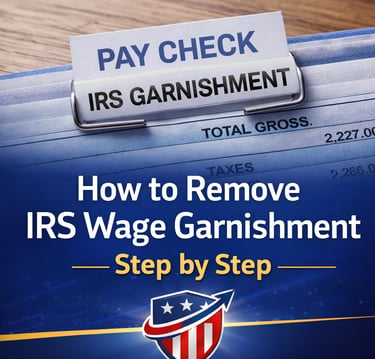
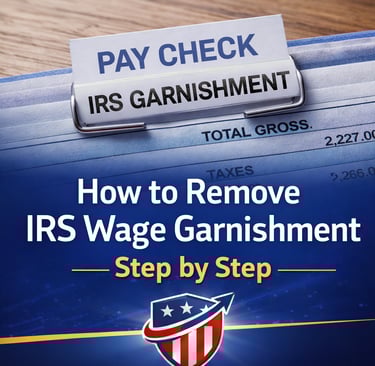
If you want a clear, step-by-step roadmap that explains exactly how wage garnishment is removed in real cases—without hype or false promises—the eBook “How to Remove IRS Wage Garnishment – Step by Step” is designed for this moment.
It focuses on:
Understanding your exact leverage point
Choosing the correct action based on timing
Avoiding mistakes that prolong garnishment
Regaining control of your cash flow
Not miracles. Not guarantees. Just clarity, structure, and informed decision-making—so you can stop reacting and start resolving.
When your paycheck is already affected, clarity saves money. Structure saves time. And knowing what actually works saves you from making the situation worse while trying to fix it.
And that is the difference between staying stuck in garnishment mode and finally moving toward resolution, because once you understand how the IRS thinks about enforcement and appeals internally, the fear fades and the process becomes manageable, even though it still requires effort and discipline, and that is where most people finally begin to feel relief—not when the garnishment stops, but when they realize they are no longer guessing, no longer reacting, and no longer at the mercy of a system they do not understand, which is ultimately the real purpose of learning how to appeal an IRS wage garnishment properly, step by step, at the right time, for the right reasons, and with the right expectations, because doing it any other way is how people stay trapped far longer than they ever needed to be, especially when the tools to change the outcome were available much earlier than they realized, if only they had known how to use them and when to use them, which is why understanding this process is not just about stopping a levy but about rebuilding financial stability one deliberate decision at a time, starting with the next one you make after finishing this sentence, which is where your control truly begins, even if it does not feel like it yet, because control in IRS matters rarely feels dramatic—it feels quiet, methodical, and slightly uncomfortable at first, right up until the moment you realize the garnishment has ended and you are no longer living paycheck to paycheck under constant threat, which is when most people finally understand that the hardest part was not the paperwork or the appeals process itself, but learning to act strategically instead of react emotionally, and that realization alone changes everything, even before the IRS formally confirms the release, because by then you already know what comes next, how to maintain compliance, and how to prevent the problem from ever reaching this stage again, which is the part most guides never explain but the part that matters most once you have been through it, because the goal is not just to remove one garnishment, but to make sure you never have to fight one again, and that is where this process ultimately leads, even if it takes time, patience, and persistence, which is why the next step is not panic, not avoidance, but deliberate action based on where you are right now, which is the only place you can start, and the only place from which real resolution ever happens, even if right now all you can do is take a breath and begin.
https://removeirswagegarnishmentusa.com/remove-irs-wage-garnishment-step-by-step
Contact
Here to help you stop wage garnishments.
infoebookusa@aol.com
© 2026. All rights reserved.