Can You Be Fired for IRS Wage Garnishment?
Blog post description.
3/9/202616 min read
Can You Be Fired for IRS Wage Garnishment?
If you are reading this, you are probably not casually curious. You are likely dealing with IRS letters, rising anxiety, and the very real fear that your paycheck—or your job—could disappear. In many cases we see, the fear of wage garnishment becomes more paralyzing than the garnishment itself. People imagine worst-case scenarios: being fired, humiliated at work, or suddenly unable to pay rent or buy groceries.
This article is written for taxpayers in that exact position.
Not in theory. Not from a classroom. But from repeated exposure to how IRS collection actions actually unfold in real life, across hundreds of situations where wage garnishment or levies were threatened, initiated, stopped, or escalated.
We will answer the core question directly and precisely:
Can you be fired because of an IRS wage garnishment?
Then we will go much deeper—because the real danger is not just the garnishment itself, but misunderstanding how and when the IRS escalates, what employers are legally allowed to do, and which actions actually stop enforcement versus which ones quietly make things worse.
Throughout this article, we will refer to the Internal Revenue Service simply as “the IRS,” because that is how taxpayers experience it in practice—not as a single monolithic agency, but as a series of departments, notices, and enforcement stages that behave in surprisingly predictable ways.
https://removeirswagegarnishmentusa.com/remove-irs-wage-garnishment-step-by-step
The Short Answer: Can You Be Fired for IRS Wage Garnishment?
Under federal law, your employer cannot legally fire you solely because of one IRS wage garnishment.
This protection comes from the Consumer Credit Protection Act (CCPA), which limits employer retaliation for a single garnishment. In practice, this means:
If the IRS issues one wage garnishment
And your employer receives and complies with it
Your employer is not allowed to terminate you because of that garnishment alone
Most taxpayers misunderstand this point. They assume that the moment payroll receives an IRS notice, their job is automatically at risk. In reality, employers are accustomed to garnishments—IRS, child support, student loans—and most have established payroll procedures to handle them quietly and routinely.
However, this is not the full story.
There are important limits, gray areas, and practical risks that are rarely explained clearly. In many cases we see, people are not fired because of the garnishment—but they still lose their job as a downstream consequence of how the situation is handled.
To understand why, you must understand how IRS wage garnishment actually works, how it differs from a levy, and how employers experience the process.
IRS Wage Garnishment vs IRS Levy: The Legal Difference That Changes Everything
One of the most damaging misunderstandings we see is taxpayers using the terms “garnishment” and “levy” interchangeably. The IRS does not.
What IRS Wage Garnishment Actually Is
Technically, when the IRS takes money directly from your paycheck, it is doing so through a wage levy. Informally, taxpayers call this “wage garnishment,” but legally it is a continuous levy on wages.
This distinction matters because:
A wage levy stays in place until the debt is resolved or released
It is not a one-time event
It can last months or even years if not addressed
In practice, this often happens when a taxpayer ignores earlier notices, assumes the IRS “will work with them later,” or believes filing paperwork alone will stop enforcement.
What an IRS Bank Levy Is (And Why It Feels More Violent)
A bank levy is different:
It targets funds already in your account
It freezes the account first
Then seizes available funds after a short holding period
Unlike wage levies, bank levies are usually one-time hits, but they can be repeated. Psychologically, they feel more aggressive because access to money disappears overnight.
One pattern that repeats across IRS enforcement actions is this:
Taxpayers fear wage garnishment, but bank levies cause the real financial collapse.
Understanding which action you are facing—and which one is coming next—is critical.
How Wage Garnishment Affects Your Paycheck in Real Life
Many people imagine IRS wage garnishment as “they take 25% of your pay.” That is not how IRS garnishment works.
IRS Garnishment Is Not Percentage-Based
Unlike private creditors, the IRS does not garnish a fixed percentage. Instead, it allows you to keep only a small exempt amount based on:
Filing status
Number of dependents
Pay frequency
Everything above that amount goes to the IRS.
In many cases we see, taxpayers are shocked by how small the exempt amount is. The result is often:
Paychecks reduced to barely survivable levels
Immediate inability to cover basic expenses
A sense of financial suffocation rather than gradual pressure
This is why IRS wage garnishment feels more severe than most other garnishments.
How Employers Are Actually Involved (And What They Care About)
Employers do not choose whether to honor an IRS wage garnishment. They are legally required to comply.
What Happens Inside Payroll
When an employer receives an IRS wage levy:
Payroll verifies the notice
They calculate the exempt amount
They withhold the required portion
They send it to the IRS each pay period
For most employers, this is administrative—not emotional. They do not judge, interrogate, or escalate internally unless something unusual happens.
In practice, employers care about three things:
Compliance – avoiding IRS penalties
Administrative burden – avoiding repeated notices
Disruption – avoiding employee conflict or payroll errors
A single garnishment rarely triggers problems. Multiple garnishments, inconsistent paperwork, or employee panic often does.
What We See Most Often in Real IRS Enforcement Cases
This section reflects repeated patterns observed across many IRS collection cases, not isolated anecdotes.
The Fear Comes Long Before the Garnishment
In many cases we see, taxpayers live in fear for months or years before any garnishment actually happens. The IRS sends a sequence of notices that feel threatening but are not yet enforcement.
This fear causes people to:
Avoid opening mail
Delay calling the IRS
Make partial payments without a plan
File forms too late to stop escalation
Ironically, the fear itself often accelerates the outcome.
Garnishment Rarely Comes Without Warning
Despite its reputation, the IRS almost never garnishes wages without sending multiple notices first. There is usually:
An initial balance notice
Follow-up reminders
A Final Notice of Intent to Levy
A notice of your right to a hearing
Most taxpayers misunderstand this point. They think the garnishment “came out of nowhere,” when in reality the warnings were present—but poorly understood.
The Employer Is Usually the Last to Know
Another repeating pattern: employers often learn about the garnishment after the taxpayer has been dealing with IRS letters for months.
This creates an emotional shock. The problem suddenly feels public. But from the employer’s perspective, it is simply a compliance task.
Common Mistakes Taxpayers Make
Mistakes—not debt—are what usually trigger the most damaging outcomes.
Mistake #1: Waiting Until Garnishment Starts to Act
Timing matters more than paperwork. In practice, options that stop garnishment are far more effective before the levy is active.
Once wages are already being taken:
Some options still work
Others become slower or less effective
Stress increases dramatically
Mistake #2: Assuming “I Filed Something” Means Protection
Many taxpayers believe filing a form automatically freezes IRS action. This is often false.
Examples include:
Submitting an Installment Agreement request without follow-up
Mailing hardship documentation without confirmation
Filing late returns without addressing collections
In many cases we see, enforcement continues because the IRS never processed—or never approved—the paperwork.
Mistake #3: Calling the IRS Without a Clear Objective
Calling the IRS without knowing what you are asking for often backfires.
Why? Because:
The IRS employee’s job is to collect or secure compliance
They respond to what you request—not what you hope for
Vague conversations can trigger deadlines or reviews
Preparation matters.
Patterns That Repeat Across IRS Collection Departments
Although the IRS feels chaotic from the outside, its internal behavior is surprisingly patterned.
Automated Collections Are Relentless but Predictable
Early-stage collections are automated. Notices go out on schedules. Responses are processed in batches.
In this stage:
The IRS rarely exercises discretion
Delays are common
Silence is interpreted as non-cooperation
Human Revenue Officers Change the Tone Completely
Once a case is assigned to a Revenue Officer, everything changes:
Enforcement becomes faster
Deadlines become real
Garnishments and levies escalate quickly
One pattern that repeats across IRS enforcement actions is this:
Taxpayers who act decisively before human assignment fare far better than those who wait.
https://removeirswagegarnishmentusa.com/remove-irs-wage-garnishment-step-by-step
Why Levies Escalate Faster Than People Expect
Bank levies and wage levies are not parallel paths. They often occur sequentially.
In many cases we see:
Wage levy begins
Taxpayer struggles but survives
IRS escalates to bank levy to accelerate payment
Financial collapse occurs
This is why stopping garnishment early is not just about paycheck relief—it is about preventing the next step.
Psychological Pressure Tactics vs Legal Reality
IRS notices are written to prompt action. They use:
Urgent language
Deadlines
Legal consequences
This creates psychological pressure. But not every threat is immediate.
Most taxpayers misunderstand this point. They either panic too early—or worse—panic too late.
Understanding which notices are procedural and which are enforcement triggers changes everything.
What Actions STOP Garnishment vs STOP Levy
Not all solutions are equal.
Options That Can Stop Wage Garnishment
Depending on timing and circumstances, these may include:
Approved Installment Agreements
Currently Not Collectible (CNC) status
Timely Collection Due Process hearings
Certain hardship determinations
Options That Stop Bank Levies but Not Wage Garnishment
Some actions release bank levies but do not automatically stop wage levies. This distinction matters.
In practice, this often happens when taxpayers focus on the most recent pain point instead of the overall strategy.
Why Timing Matters More Than Paperwork
We see this repeatedly: two taxpayers file the same form. One succeeds. One fails.
The difference is timing.
Before Final Notice → options are broad
After levy notice → options narrow
After levy begins → options slow down
The IRS responds very differently depending on where you are in the timeline.
When Fighting Back Actually Works vs When It Backfires
There are moments when pushing back is effective—and moments when it is dangerous.
Filing appeals too late, disputing valid balances, or ignoring deadlines often accelerates enforcement.
In contrast, targeted, timely action aligned with IRS procedure often produces relief.
Knowing the difference is what separates control from chaos.
Can You Be Fired If Garnishment Happens More Than Once?
Here is where the risk increases.
Federal law protects you from termination due to one garnishment. It does not necessarily protect you from multiple garnishments—especially from different creditors.
In many cases we see:
IRS garnishment + child support
IRS garnishment + state tax levy
IRS garnishment + private creditor
At that point, employers may have legal flexibility they did not have before.
This is why preventing escalation matters—not just surviving the first garnishment.
The Real Risk Is Not Termination—It Is Financial Erosion
Most people who lose jobs during IRS collection do not lose them because of a single garnishment. They lose them because:
Stress affects performance
Transportation or housing becomes unstable
Secondary financial crises emerge
Stopping garnishment early protects more than income—it protects stability.
Final Thoughts Before We Move to Solutions
If you are facing IRS wage garnishment, the situation is serious—but it is not hopeless.
What matters most is not fear, paperwork, or promises. It is understanding how the IRS actually behaves, where you are in the enforcement timeline, and which actions produce real results at that stage.
Take Back Control With a Clear, Structured Plan
If you want step-by-step clarity—without hype or false guarantees—our guide:
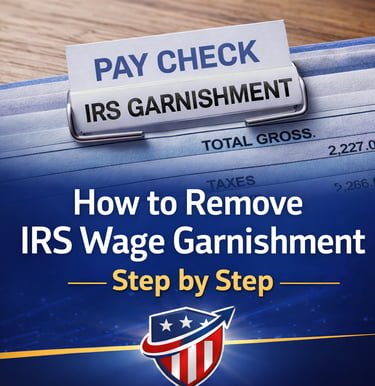
How to Remove IRS Wage Garnishment – Step by Step
was created specifically for taxpayers in this position.
It focuses on:
Understanding your exact enforcement stage
Choosing actions that actually stop garnishment
Avoiding mistakes that escalate levies
Regaining cash flow while protecting long-term stability
Not miracles. Not shortcuts. Just a structured path to control, clarity, and saving money when timing matters most.
When you’re ready to move from fear to informed action, that’s where to start.
continue
…where to start.
How the IRS Notice Timeline Really Leads to Wage Garnishment
One of the most damaging misunderstandings we see is the belief that IRS wage garnishment is sudden or arbitrary. In reality, it follows a very specific notice sequence, and the IRS almost never skips steps. What taxpayers miss is which notice actually matters.
The Early Notices Most People Ignore
In many cases we see, the first letters are treated as “informational” or “low priority.” These typically include:
Initial balance due notices
Reminder notices showing penalties and interest
Automated follow-ups that look repetitive
At this stage, the IRS is not enforcing. It is documenting noncompliance. Silence during this phase does not trigger immediate action, but it builds the file.
One pattern that repeats across IRS enforcement actions is that taxpayers underestimate the importance of responding early, even if they cannot pay.
The Critical Shift: Final Notice of Intent to Levy
Everything changes when the IRS issues a Final Notice of Intent to Levy and Notice of Your Right to a Hearing.
This notice is not just another letter. It is the legal gateway to enforcement.
In practice, this often happens when:
Returns are filed but balances remain unpaid
No approved payment plan is in place
Previous notices received no meaningful response
From this point forward, the IRS has legal authority to levy wages and bank accounts after the waiting period expires.
Most taxpayers misunderstand this point. They think the “final notice” means “last warning before collections someday.” In reality, it means enforcement can begin very soon.
The 30-Day Window That Changes Outcomes
After the Final Notice of Intent to Levy, there is usually a 30-day window where certain actions can legally pause enforcement.
What happens during this window determines whether garnishment is avoided or becomes almost inevitable.
In many cases we see:
Taxpayers delay action until day 28 or 29
Forms are mailed but not received in time
Phone calls are made without submitting the correct request
Timing matters more than paperwork. A perfect form filed too late often accomplishes nothing.
Why IRS Wage Garnishment Feels So Personal at Work
Even though wage garnishment is procedural, the emotional impact at work is intense.
Loss of Privacy Is the Real Shock
For most people, this is the first time a financial problem becomes visible to an employer. Payroll departments may need to ask clarifying questions. HR may be notified.
In practice, employers usually handle this discreetly—but the taxpayer feels exposed.
This emotional reaction often leads to poor decisions:
Confronting payroll aggressively
Oversharing details with supervisors
Panicking and quitting jobs prematurely
We see this repeatedly, and it often worsens the situation.
Employers Are Not the IRS—and That Matters
Employers do not decide:
How much is taken
When the garnishment starts
When it ends
They are intermediaries, not enforcers.
In many cases we see, tension at work comes not from employer hostility, but from employee stress spilling into interactions.
Understanding this helps preserve employment stability during enforcement.
IRS Wage Garnishment vs Bank Levy: Cash Flow Damage Compared
Both actions hurt, but they hurt differently.
Wage Garnishment Is Slow Suffocation
A wage levy:
Reduces each paycheck
Continues indefinitely
Creates chronic stress
In practice, this often leads to:
Falling behind on bills
Using credit to survive
Gradual financial erosion
Bank Levy Is Sudden Trauma
A bank levy:
Freezes funds immediately
Disrupts rent, utilities, and food access
Creates instant crisis
One pattern that repeats across IRS collection departments is this:
Taxpayers who survive wage garnishment without a plan often collapse when the first bank levy hits.
The IRS uses bank levies strategically when wage garnishment alone is not producing fast enough results.
How and Why Levies Escalate Faster Than Expected
Many taxpayers assume enforcement will stay “stable” once garnishment begins. This is rarely true.
The IRS Is Always Measuring Progress
The IRS monitors:
How much is being collected
How quickly balances decline
Whether the taxpayer is compliant going forward
If progress is slow—or if new liabilities arise—enforcement escalates.
In practice, this often happens when:
Garnishment leaves the taxpayer barely functioning
No long-term resolution is approved
Communication with the IRS stops
Escalation is not personal. It is procedural.
What Actually Stops IRS Wage Garnishment (And What Does Not)
This is where misinformation causes the most harm.
Actions That Commonly STOP Garnishment
Depending on timing and eligibility, these include:
Approved Installment Agreements
Once accepted and active, wage levies are typically released.Currently Not Collectible (CNC) Status
When financial hardship is demonstrated and accepted.Timely Collection Due Process (CDP) Requests
Filed within the allowed window after Final Notice.Certain Appeals or Holds
When correctly requested and acknowledged.
In practice, these only work when approved, not merely submitted.
Actions That Often FAIL to Stop Garnishment
We see these mistakes constantly:
Mailing forms without confirmation
Assuming verbal statements “put notes on the account”
Filing incomplete financial disclosures
Waiting for callbacks that never come
The IRS acts based on system status, not intentions.
Which Options Apply to Both Garnishment and Levy—and Which Do Not
This distinction matters more than most people realize.
Options That Can Stop Both
Approved payment plans
CNC status
Certain appeals
Options That May Stop Bank Levies but Not Wage Garnishment
Emergency levy releases
Partial hardship claims
Short-term holds
In many cases we see, taxpayers stop the bank levy but assume wages are safe—only to see garnishment continue.
Understanding this prevents false relief.
Why Timing Matters More Than Any Single Form
Two taxpayers can submit identical requests with completely different outcomes.
The difference is usually where they are in the enforcement timeline.
Before Final Notice → broad discretion
After Final Notice but before levy → limited protection
After levy begins → damage control
Most taxpayers focus on what to file, not when. The IRS focuses on timing.
When Fighting Back Works—and When It Backfires
There is a moment when pushing back is effective—and a moment when it accelerates enforcement.
When Fighting Back Works
Challenging incorrect balances early
Requesting hearings within deadlines
Providing complete financial disclosures
When Fighting Back Backfires
Disputing valid debt late
Filing appeals purely to delay
Ignoring deadlines while “preparing”
In many cases we see, taxpayers unintentionally signal noncooperation, triggering faster enforcement.
Can Multiple Garnishments Cost You Your Job?
This is where job risk becomes real.
Federal law protects against termination due to one garnishment. It does not guarantee protection when:
Multiple garnishments exist
Administrative burden becomes excessive
Employer policies are triggered
In practice, this often happens when IRS garnishment is layered on top of:
Child support
State tax debts
Private judgments
Preventing additional enforcement is critical.
The Real Objective: Preventing the Second Crisis
Most taxpayers focus on surviving the first garnishment. The smarter objective is preventing the second enforcement action.
That second action—usually a bank levy—is what destroys stability.
In many cases we see, those who act decisively early maintain employment, housing, and dignity. Those who delay spiral.
Final Perspective: Control Beats Fear
IRS wage garnishment is not the end of your financial life. But misunderstanding it often is.
The IRS follows patterns. Employers follow rules. Outcomes depend on timing, clarity, and strategy—not panic.
Take the Next Step With Structure, Not Guesswork
If you want a clear, step-by-step path—built around how IRS collections actually unfold—the guide:
How to Remove IRS Wage Garnishment – Step by Step
exists for one reason: to replace fear with control.
It walks through:
Identifying your exact enforcement stage
Choosing actions that actually stop garnishment
Avoiding mistakes that trigger levies
Protecting cash flow while reducing long-term damage
No hype. No guarantees. Just a structured, practical roadmap for navigating one of the most stressful IRS enforcement actions taxpayers face.
When timing matters—and it does—clarity saves money, stability, and peace of mind.
continue
…peace of mind.
How Employers Typically React in Real IRS Wage Garnishment Situations
To understand whether you can be fired—and why most people aren’t—you have to look at this from the employer’s side, not the taxpayer’s.
In many cases we see, taxpayers assume their employer views IRS garnishment as a red flag about character or reliability. In practice, employers usually see it as a compliance event, not a moral judgment.
Payroll Departments See Garnishments Constantly
Large employers process garnishments every single payroll cycle. Smaller employers see them less often, but even then, IRS wage levies are not shocking or rare.
From payroll’s perspective:
The IRS notice is standardized
The calculations are mechanical
The obligation is mandatory
There is usually no internal discussion about whether the employee “deserves” the garnishment. The only concern is doing it correctly to avoid penalties.
Most taxpayers misunderstand this point. They project their own fear and shame onto the employer, when the employer is focused on process.
When Employer Friction Actually Appears
Problems arise when the garnishment creates operational friction, not because of the debt itself.
In practice, this often happens when:
Multiple garnishments overlap
Employees argue with payroll about withholding amounts
Paperwork is incomplete or contradictory
IRS sends repeated correction notices
One pattern that repeats across IRS enforcement actions is this:
Job risk increases not because of garnishment, but because of disruption.
Stability and predictability matter more to employers than the existence of debt.
Why Some People Still Lose Jobs During IRS Garnishment
This is an uncomfortable truth, but it needs to be stated clearly.
People sometimes lose jobs during IRS wage garnishment. They almost never lose them because of IRS wage garnishment alone.
Secondary Effects That Cause Job Loss
In many cases we see, termination happens because of:
Chronic stress leading to absenteeism
Transportation issues after bank levies
Housing instability affecting work performance
Emotional outbursts at work due to pressure
The garnishment is the trigger, not the cause.
Understanding this distinction shifts the focus from fear of being fired to protecting overall stability.
IRS Collection Departments Do Not Communicate the Way You Think
Another major source of confusion is the belief that “the IRS” is a single entity that sees everything instantly.
In practice, it is fragmented.
Automated Collections vs Human Enforcement
Early collections are automated. Once enforcement escalates, human revenue officers may step in.
These departments:
Do not always see the same information at the same time
May not be aware of pending paperwork
Rely heavily on system status codes
This is why taxpayers who “sent something in” still get garnished.
One pattern that repeats across IRS collection departments is delay between submission and recognition. Enforcement does not pause just because paperwork is in transit.
Why Calling the IRS Feels Useless (But Sometimes Isn’t)
Many taxpayers call the IRS repeatedly and feel like nothing changes.
There is a reason.
IRS Phone Calls Are Transactional, Not Strategic
When you call:
The representative responds to what is visible on the system
They cannot act on documents not yet processed
They follow scripts and authority limits
In practice, this often means:
You are told to wait
Notes are added that do not stop enforcement
Deadlines continue running
Calling without a clear, time-sensitive request rarely changes outcomes.
The Difference Between “On Hold” and “Protected”
Another dangerous misunderstanding is the idea that a temporary hold equals safety.
In many cases we see, taxpayers are told:
“There’s a hold on your account”
“Collections are paused”
“Wait for processing”
But there are different types of holds.
Temporary Administrative Holds
These may:
Last days or weeks
Expire automatically
Not block levy authority
Legal Protections
These include:
Approved agreements
Active appeals
Formal CNC status
Only the latter reliably stop garnishment.
Most taxpayers misunderstand this point and relax too early.
IRS Psychological Pressure vs Actual Legal Risk
IRS notices are intentionally stressful. They are designed to provoke action.
But not all pressure equals immediate danger.
Why the IRS Uses Escalating Language
The IRS increases urgency to:
Prompt voluntary compliance
Reduce the need for enforcement
Establish a record of notice
This is psychological pressure layered on legal authority.
Understanding which notices are pressure and which are triggers prevents panic—and paralysis.
When Timing Alone Determines the Outcome
We have seen cases where nothing about the taxpayer changed—income, debt, hardship—but the result changed entirely because of when action was taken.
Early Action vs Late Action
Early action often leads to:
Manageable payment plans
No garnishment
Preserved cash flow
Late action often leads to:
Wage levies
Bank levies
Damage control mode
The IRS does not retroactively reward good intentions.
What Happens After Wage Garnishment Starts (Step by Step)
Once wages are being garnished, many people freeze. They assume the situation is locked in.
It is not—but options narrow.
Immediate Aftermath
Employer implements withholding
First reduced paycheck arrives
Shock and panic set in
IRS Monitoring Phase
The IRS watches:
Payment flow
Compliance with new taxes
Any contact or requests
Escalation Decision
If progress is slow or silence continues, escalation becomes likely.
This is why taking action after garnishment begins still matters—but requires precision.
Why Some “Solutions” Quietly Make Things Worse
Not all attempts to fix the problem help.
In practice, we see harm caused by:
Partial payments without agreements
Filing new returns without addressing old debt
Moving money to avoid levies
Quitting jobs to escape garnishment
These actions often trigger faster enforcement.
The Myth of “Waiting It Out”
Some taxpayers believe the IRS will eventually stop trying.
This is rarely true.
Interest accrues. Penalties compound. Enforcement renews.
The IRS has time. Most taxpayers do not.
Long-Term Consequences of Ignoring Garnishment
Even if you survive month to month, the long-term impact can include:
Increased total debt
Reduced credit access
Repeated enforcement cycles
Stopping garnishment is not just about relief—it is about preventing a multi-year spiral.
Why Structured Action Beats Reactive Panic
In many cases we see, the taxpayers who regain control are not the wealthiest or most sophisticated. They are the ones who:
Understand the enforcement stage
Choose actions aligned with that stage
Follow through precisely
Structure beats emotion every time.
Bringing It Back to the Original Question
Can you be fired for IRS wage garnishment?
Legally, for a single garnishment, no.
Practically, stability depends on how you handle the situation.
Avoiding escalation protects not just your paycheck, but your job, housing, and mental health.
A Calm, Practical Next Step
If you are facing IRS wage garnishment—or fear it is coming—the most valuable thing you can gain is clarity.
The guide:
How to Remove IRS Wage Garnishment – Step by Step
was built for this exact moment.
It does not promise miracles. It does not rely on theory. It walks through:
How to identify where you are in the IRS timeline
Which actions actually stop garnishment at each stage
How to avoid mistakes that trigger bank levies
How to regain control of cash flow without making things worse
Clarity creates control. Control saves money. And in IRS enforcement, timing makes all the difference.
If you are ready to replace fear with informed action, that is the place to begin
https://removeirswagegarnishmentusa.com/remove-irs-wage-garnishment-step-by-step
Contact
Here to help you stop wage garnishments.
infoebookusa@aol.com
© 2026. All rights reserved.