
Can IRS Garnish Tips, Commissions, or Gig Income?
Blog post description.
4/1/20268 min read
Can IRS Garnish Tips, Commissions, or Gig Income?
If you are reading this, there is a good chance you are not asking out of curiosity. In many cases we see, taxpayers arrive at this question after a notice lands in the mailbox, a bank account suddenly drops to zero, or an employer quietly pulls them aside and says, “We received something from the IRS.”
The fear is usually the same: Can the IRS really take this money too? Tips. Commissions. Side gigs. 1099 income. App-based work. Cash flow that already feels unstable.
The short answer is yes—but the way the IRS does it, how fast it happens, and what actually stops it are widely misunderstood. Most taxpayers misunderstand this point, and that misunderstanding is exactly what causes situations to spiral from “manageable” to “financially suffocating.”
What follows is not theory. It reflects patterns repeated across real IRS enforcement actions, watched from the first automated notice through the moment money stops hitting the account.
https://removeirswagegarnishmentusa.com/remove-irs-wage-garnishment-step-by-step
Understanding IRS Collection Power at a Practical Level
Before breaking down tips, commissions, and gig income specifically, it is critical to understand how the IRS collects at all. Many people use the words garnishment and levy interchangeably. The IRS does not.
IRS Collection Is Administrative, Not Judicial
One pattern that repeats across IRS enforcement actions is surprise. Taxpayers assume there will be a judge, a court date, or a dramatic final warning. In practice, the IRS does not need a court order to seize income or bank funds.
This is administrative authority granted under federal law. Once certain notices are issued—and ignored—the IRS can act.
This distinction matters because:
There is no last-minute courtroom intervention
Timing, not argument quality, determines outcomes
Waiting for “proof” often means waiting too long
The Legal Difference Between IRS Wage Garnishment and IRS Levy
This distinction drives everything else in this article.
What the IRS Calls a “Wage Garnishment”
Technically, the IRS does not use the term garnishment the same way state courts do. The IRS issues a wage levy that functions like a garnishment.
In practice, this means:
A levy is sent directly to your employer
The employer is legally required to comply
Most of your paycheck is diverted to the IRS
This continues every pay period
The key feature here is continuity. Once a wage levy is in place, it does not automatically expire. It stays active until:
The debt is resolved
The levy is released
The IRS agrees to stop it
Many taxpayers believe it is a one-time hit. That belief causes inaction during the most critical window.
What the IRS Means by a Levy (Bank or Asset Levy)
A levy, more broadly, is the legal seizure of property or rights to property. This includes:
Bank accounts
Accounts receivable
Third-party payments
Retirement accounts
Certain income streams
A bank levy is usually one-time, but that does not mean it is harmless. In practice, it often empties accounts at the worst possible moment—rent week, payroll week, tax payment week.
Most taxpayers misunderstand this point: bank levies feel sudden, but they are usually the result of ignored earlier notices.
How Garnishment vs. Levy Affects Cash Flow Differently
Understanding how money is disrupted matters more than understanding legal language.
Wage Garnishment: Slow Suffocation
In many cases we see, wage garnishment creates a long-term cash flow crisis rather than an immediate collapse.
Effects include:
Paychecks shrink dramatically
Fixed expenses become impossible to cover
Credit cards and loans fill the gap
The taxpayer stays “alive” but underwater
Because the garnishment continues, stress compounds. People borrow to survive, which makes resolution harder later.
Bank Levies: Immediate Shock
Bank levies feel violent because they are concentrated.
Common outcomes:
Entire checking account frozen and swept
Automatic payments bounce
Secondary fees cascade
Employer payroll deposits are intercepted
In practice, bank levies often push taxpayers into panic mode, but paradoxically, they are sometimes easier to resolve than wage garnishments once action is taken.
Can the IRS Garnish Tips?
This is one of the most misunderstood areas.
Tips Paid Through Payroll
If tips are reported and processed through payroll—as is common in restaurants, hospitality, and service industries—they are treated as wages.
In practice, this means:
IRS wage levy applies
Tips are included in the garnished amount
Employer calculates exempt portion, not the IRS
You have little control once it starts
Many taxpayers assume tips are “off limits” because they fluctuate. That assumption is incorrect when tips pass through payroll systems.
Cash Tips Outside Payroll
Here is where things become more nuanced.
Cash tips that are:
Not reported
Not processed through payroll
Not deposited into a bank account
are not directly garnished as tips. However, this does not mean they are safe.
One pattern that repeats across IRS collection departments is indirect capture:
Cash tips are deposited into a bank
Bank levy captures them
Income is later reconstructed for assessments
In practice, relying on cash tips to avoid IRS action creates long-term risk. It does not resolve the debt, and it often escalates enforcement later.
Can the IRS Garnish Commissions?
Yes—and commissions are often easier for the IRS to intercept than hourly wages.
Commissions Paid Through an Employer
If commissions are paid by an employer:
They are wages under IRS levy rules
The levy applies regardless of variability
Large commission checks can be almost entirely seized
In many cases we see, sales professionals are shocked when a six-month commission payout disappears. The IRS does not prorate hardship. The exemption formula is minimal.
Independent Contractor Commissions
If commissions are paid to a 1099 contractor:
The IRS may issue a levy to the payer
Payments can be redirected
Future receivables may be intercepted
Most taxpayers misunderstand this point: being a contractor does not shield income from levy. It simply changes who receives the levy notice.
https://removeirswagegarnishmentusa.com/remove-irs-wage-garnishment-step-by-step
Can the IRS Take Gig Income?
This is where modern enforcement has quietly evolved.
Platform-Based Gig Work
Ride-share drivers, delivery workers, freelancers, and app-based contractors often believe they are invisible.
In practice, what we see:
Platforms receive IRS levies
Payments are frozen or redirected
Accounts may be suspended due to compliance obligations
The IRS does not need your cooperation. It contacts the entity controlling payment.
Bank-Level Capture of Gig Income
Even when platforms are not directly levied:
Payments flow into bank accounts
Bank levies seize accumulated funds
Timing determines damage level
One pattern that repeats across IRS enforcement actions is escalation after gig income increases. Higher deposits trigger faster attention.
IRS Notice Timeline Leading to Garnishment or Levy
Timing matters more than paperwork. This is not an exaggeration.
The Early Notices Most People Ignore
In many cases we see, the first notices are:
CP14 (balance due)
CP501 and CP503 reminders
Language that feels non-threatening
These notices are automated. They are not idle.
The Critical Final Notices
The real danger begins with:
Final Notice of Intent to Levy
Notice of Your Right to a Hearing
At this stage:
Deadlines are real
Rights expire
IRS computers queue enforcement
Most taxpayers misunderstand this point: calling the IRS after a levy notice is not the same as stopping a levy.
Psychological Pressure Tactics vs. Legal Reality
The IRS does not need to threaten loudly. The system itself applies pressure.
How Pressure Is Applied
In practice, pressure comes from:
Silence after notices
Sudden enforcement
Employer involvement
Loss of control
This creates urgency that often leads to bad decisions.
What Is Actually Legally Required
The IRS must:
Send proper notices
Allow certain response windows
Follow levy procedures
But they do not have to:
Warn you again
Negotiate by default
Pause because you are stressed
Knowing the difference prevents panic-driven mistakes.
How Employers and Banks Are Involved
Understanding third-party behavior helps you predict outcomes.
Employers Have No Discretion
Once an employer receives a levy:
They must comply
They cannot negotiate for you
They face penalties if they ignore it
In many cases we see, employers act quickly to protect themselves, not you.
Banks Act Faster Than Expected
Banks:
Freeze accounts immediately
Release funds to IRS after holding period
Do not reverse without IRS instruction
Calling the bank rarely helps.
What Actions STOP Garnishment vs. STOP Levy
This is where confusion causes the most damage.
Actions That Can Stop a Wage Garnishment
In practice, wage levies are stopped by:
Installment agreements
Currently Not Collectible status
Offer in Compromise acceptance
Levy release requests with proof
Not all actions work once the levy is active.
Actions That Can Stop a Bank Levy
Bank levies can sometimes be reversed if:
Timing is immediate
Hardship is proven
Procedural errors occurred
Delay removes options.
Which Options Apply to Both—and Which Do Not
Most taxpayers assume one solution fits all. It does not.
Options That Can Stop Both
Certain resolutions affect both:
Full payment
Approved installment agreements
CNC status
Options That Do Not
Some actions:
Stop wage levies but not bank levies
Delay but do not cancel enforcement
Backfire if applied too late
Timing determines effectiveness.
Why Timing Matters More Than Paperwork
In practice, beautifully prepared paperwork submitted late does nothing.
One pattern that repeats across IRS enforcement actions is urgency miscalculation. Taxpayers spend weeks researching, then miss a deadline by days.
The IRS system does not pause for preparation.
When Fighting Back Works—and When It Backfires
Resistance is not always smart.
When Action Helps
It helps when:
Notices are still active
Deadlines are open
Financial data supports relief
When It Backfires
It backfires when:
You argue instead of resolve
You trigger reviews
You escalate without leverage
What We See Most Often in Real IRS Enforcement Cases
In many cases we see, taxpayers are not reckless—they are overwhelmed.
The most common sequence looks like this:
Initial notice ignored due to stress
Second notice postponed mentally
Final notice misunderstood
Enforcement hits suddenly
Panic leads to reactive decisions
Once enforcement begins, options narrow fast.
We see taxpayers with solid resolution eligibility lose leverage simply because timing slipped. We also see cases where early, calm action prevented any seizure at all.
Common Mistakes Taxpayers Make
Most taxpayers misunderstand this point: the IRS is predictable.
Common mistakes include:
Waiting for a “real” threat
Assuming income type is protected
Believing cash flow equals invisibility
Calling too late
Sending paperwork without strategy
These mistakes repeat because fear distorts perception.
Patterns That Repeat Across IRS Collection Departments
Across Automated Collections, Field Collections, and Specialty Units, patterns repeat:
Silence escalates action
Partial cooperation triggers scrutiny
Timing determines mercy
Systems move faster than people expect
Understanding these patterns changes outcomes.
Taking Back Control Before Income Is Taken
The goal is not to “beat” the IRS. It is to regain predictability.
Clarity comes from understanding:
What income is exposed
How fast enforcement moves
Which actions actually stop seizures
When to act—not just how
If you are already facing wage garnishment, or you see it approaching, structured guidance matters.
A Clear, Step-by-Step Way Forward
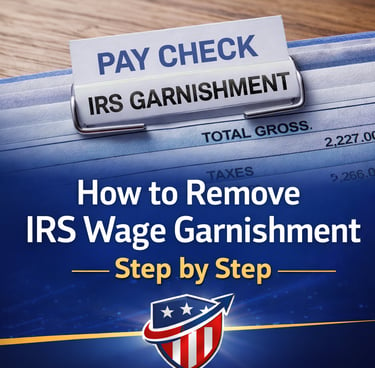
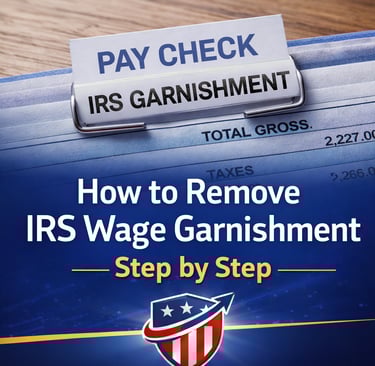
If you want a calm, organized walkthrough of how wage garnishment is actually removed—based on real enforcement behavior, not theory—the guide “How to Remove IRS Wage Garnishment – Step by Step” was created for exactly this situation.
It does not promise miracles. It does not rely on hype. It lays out:
What stops garnishment
When each option works
How to avoid triggering worse outcomes
How to regain control of your paycheck without guesswork
For many taxpayers, clarity alone saves thousands—by preventing escalation, penalties, and unnecessary seizures.
If you are already under pressure, structure matters more than optimism.
continue
For taxpayers who are already dealing with shrinking paychecks, frozen accounts, or the constant fear that the next deposit will be taken, the value of a structured roadmap is not emotional reassurance—it is time saved and damage avoided.
In many cases we see, people lose far more money from hesitation, missteps, and trial-and-error than from the original tax balance itself. Garnishments linger for months longer than necessary. Levies hit accounts that could have been protected. Options expire while taxpayers are still trying to understand which form to download.
That is exactly the gap the eBook “How to Remove IRS Wage Garnishment – Step by Step” is designed to fill.
It walks through the actual sequence the IRS follows, how wage levies are released in practice, and how to move from enforcement back to control without guessing or reacting blindly. It does not assume you are a tax expert. It assumes you are under pressure and need clarity.
What readers usually find most useful is not any single tactic, but the order of operations:
What to do first
What not to do yet
When waiting helps
When waiting quietly makes things worse
In practice, this sequencing is what separates cases that stabilize quickly from cases that drag on, draining income month after month.
If your tips, commissions, or gig income are already being affected—or you are trying to prevent that from happening—the goal is not to fight the IRS emotionally or aggressively. The goal is to interrupt the enforcement machine at the right point, with the right action, before more money is taken than necessary.
For many taxpayers, having that structure in front of them changes the entire experience from reactive to controlled. It replaces fear with decision paths. It replaces uncertainty with timing.
If you want that kind of clarity, the guide is there to help you work through the process calmly, step by step, and regain control over your income before enforcement defines the outcome.
https://removeirswagegarnishmentusa.com/remove-irs-wage-garnishment-step-by-step
Contact
Here to help you stop wage garnishments.
infoebookusa@aol.com
© 2026. All rights reserved.