
IRS Wage Garnishment and Bankruptcy: What Really Stops It?
Blog post description.
3/2/202610 min read
IRS Wage Garnishment and Bankruptcy: What Really Stops It?
If you are reading this, you are likely already under pressure. You may have IRS letters spread across a table, unopened envelopes stacked in a drawer, or a growing fear every time your phone rings or your paycheck posts. You may have heard words like “levy,” “garnishment,” or “bankruptcy” but are unsure what they actually mean in practice—or which, if any, truly stop the IRS once enforcement begins.
This article is written for taxpayers in that exact position. It is not theory. It is not a high-level overview. It reflects what repeatedly happens in real IRS collection cases, from the first notice through wage garnishment, bank levies, and the moments when action still makes a difference.
Most taxpayers misunderstand where the real pressure points are. They also misunderstand what bankruptcy does and does not stop, how fast IRS enforcement escalates, and which actions actually interrupt the process versus which simply delay the inevitable.
The goal here is clarity. Not comfort. Not fear. Clarity.
https://removeirswagegarnishmentusa.com/remove-irs-wage-garnishment-step-by-step
Understanding IRS Wage Garnishment and IRS Levies
Before anything else, one distinction must be made absolutely clear, because confusion here causes many people to take the wrong action at the worst possible time.
IRS Wage Garnishment Is a Continuous Action
When the IRS garnishes wages, it issues a wage levy to your employer. This is not a one-time seizure. It is an ongoing legal command that requires your employer to send a large portion of each paycheck directly to the IRS.
In practice, this often happens after months—or years—of ignored notices. Once active, the garnishment continues until one of the following occurs:
The tax debt is paid in full
The levy is formally released
The statute of limitations expires
The IRS agrees to a qualifying resolution
Bankruptcy triggers a temporary legal halt
Unlike many private creditors, the IRS does not need a court judgment to garnish wages. The authority comes from federal statute, not a lawsuit.
IRS Bank Levies Are Usually One-Time Events—But Can Repeat
A bank levy works differently. When the IRS levies a bank account, it freezes the funds in that account on the day the levy hits. The bank then holds those funds—usually for 21 days—before sending them to the IRS.
Most taxpayers assume this is a one-time event. In reality, nothing prevents the IRS from issuing multiple bank levies, especially if the underlying issue remains unresolved.
One pattern that repeats across IRS enforcement actions is this: taxpayers focus entirely on the money already taken, rather than addressing the conditions that allow future levies to occur.
Why the Difference Matters
The difference between garnishment and levy is not academic. It affects:
Cash flow stability
Ability to pay rent, utilities, and food
Employer relationships
Emotional stress and decision-making
Wage garnishment slowly strangles cash flow. Bank levies deliver sudden shocks. Both can coexist.
How Garnishment and Levies Affect Cash Flow Differently
In many cases we see, taxpayers underestimate how destructive wage garnishment is compared to a single bank levy.
Wage Garnishment: The Long Drain
The IRS calculates exempt income based on filing status and dependents. Everything above that amount is subject to garnishment.
For many taxpayers, this means losing 50–70% of take-home pay.
This creates a cascading effect:
Rent falls behind
Credit cards are used for basics
Utilities lapse
New debt accumulates
Emotional fatigue sets in
Once garnishment starts, taxpayers often become reactive rather than strategic. That is exactly when poor decisions happen.
Bank Levies: The Sudden Collapse
A bank levy may take everything available at that moment—sometimes thousands of dollars overnight. Payroll deposits, tax refunds, savings, and emergency funds can vanish.
What most taxpayers misunderstand is this point: the levy does not need to match the debt amount. The IRS can seize whatever is there, even if it only partially satisfies the balance.
Why Timing Becomes Critical
Once garnishment begins, the IRS has already completed several internal steps. At that stage, options narrow dramatically.
Bank levies often happen faster than expected because the IRS does not need to notify you again once the final notice requirements are met.
IRS Notice Timeline Leading to Enforcement
Most taxpayers believe garnishment or levy happens “suddenly.” In reality, the IRS follows a predictable notice sequence—though many people don’t recognize it until it’s too late.
Early Notices: CP14, CP501, CP503
These initial notices are informational. They state:
Amount owed
Penalties and interest
Payment instructions
At this stage, enforcement is not imminent. This is when flexibility is highest.
Escalation Notices: CP504
This is where tone shifts. The CP504 warns of intent to levy state refunds and mentions possible enforcement.
Most taxpayers misread this notice as the final step. It is not.
Final Notice of Intent to Levy (LT11 / Letter 1058)
This letter is the true turning point. Once issued, the IRS has satisfied its legal requirement to levy assets.
From this point forward, timing matters more than paperwork.
In practice, this often happens when the IRS computer system flags repeated nonresponse.
Employer and Bank Involvement Begins Quietly
The IRS does not warn you before contacting employers or banks. Once the levy is issued, third parties must comply.
Employers face penalties if they ignore wage levies. Banks freeze accounts immediately.
Psychological Pressure vs Legal Reality
One pattern that repeats across IRS enforcement actions is the use of psychological pressure long before legal force is applied.
Letters Are Designed to Trigger Panic or Avoidance
The IRS understands human behavior. Letters escalate in tone to push taxpayers into either paying immediately or disengaging entirely.
Many people do nothing because they feel overwhelmed. Ironically, this increases enforcement risk.
Phone Calls Often Add Confusion, Not Clarity
IRS phone representatives are limited in authority. They cannot always stop enforcement—even when they sound reassuring.
Most taxpayers misunderstand this point: verbal assurances do not stop automated enforcement.
Only specific actions placed into the IRS system actually halt levies or garnishments.
What Actually Stops IRS Wage Garnishment
Stopping garnishment requires interrupting enforcement authority, not just communicating hardship.
Actions That Can Stop Garnishment
In practice, these actions work when done correctly and timely:
Entering a qualifying installment agreement
Being placed in Currently Not Collectible status
Filing a Collection Due Process appeal before the deadline
Submitting an Offer in Compromise that is accepted for processing
Filing bankruptcy (temporary halt)
Actions That Do NOT Stop Garnishment
We see many taxpayers waste time on actions that feel productive but change nothing:
Partial payments without agreements
Sending letters without legal standing
Arguing fairness or hardship verbally
Ignoring employer involvement
Once garnishment begins, options narrow fast.
Bankruptcy and IRS Garnishment: What Really Happens
Bankruptcy is often misunderstood as a universal stop button. It is not.
Automatic Stay: What It Stops
When bankruptcy is filed, an automatic stay generally halts:
Wage garnishments
Bank levies
Collection calls
New enforcement actions
This happens immediately upon filing.
What Bankruptcy Does NOT Do Automatically
It does not erase all tax debt
It does not stop all IRS actions permanently
It does not guarantee discharge of taxes
In many cases we see, taxpayers file bankruptcy primarily to stop garnishment—but exit bankruptcy still owing nondischargeable tax debt.
https://removeirswagegarnishmentusa.com/remove-irs-wage-garnishment-step-by-step
Timing Is Everything
If bankruptcy is filed after funds are already seized, recovery may be limited.
If filed before garnishment starts, it can prevent months of financial damage.
What We See Most Often in Real IRS Enforcement Cases
This section reflects repeated patterns observed across hundreds of cases.
Delay Is the Biggest Enemy
Most taxpayers wait too long, hoping the issue resolves itself.
By the time garnishment begins, they have already lost leverage.
People Focus on the Wrong Threat
Taxpayers fear lawsuits or criminal charges. In reality, wage garnishment is far more common and damaging.
Conflicting Advice Creates Paralysis
Online forums, friends, and outdated articles often give contradictory guidance, causing inaction.
Common Mistakes Taxpayers Make
Mistakes here are costly—not just financially, but emotionally.
Ignoring “Small” Notices
Early notices are the safest point to act.
Assuming One Action Covers Everything
An installment agreement may stop garnishment but not address future levies if defaulted.
Waiting for the IRS to Explain Options
The IRS does not guide taxpayers toward optimal outcomes. It enforces.
Patterns That Repeat Across IRS Collection Departments
Different IRS departments behave differently—but patterns repeat.
Automation Drives Enforcement
Computer systems escalate cases without emotional judgment.
Human Review Comes Late
By the time a person reviews the file, enforcement is often already authorized.
Resolution Requires Alignment
Stopping enforcement requires aligning the right request with the right department at the right time.
When Fighting Back Works—and When It Backfires
Challenging the IRS can work—but only when grounded in timing and authority.
When It Works
Timely appeals
Properly documented hardship
Accurate financial disclosures
When It Backfires
Frivolous arguments
Missed deadlines
Incomplete submissions
Final Thoughts Before You Take Action
Most taxpayers do not need miracles. They need structure, timing, and clarity.
IRS wage garnishment feels overwhelming because it removes control. The path forward is about restoring that control—not through panic, but through informed, deliberate steps.
A Practical Next Step
If you want a clear, structured walkthrough focused specifically on removing IRS wage garnishment—without hype or promises—you may find value in the eBook:
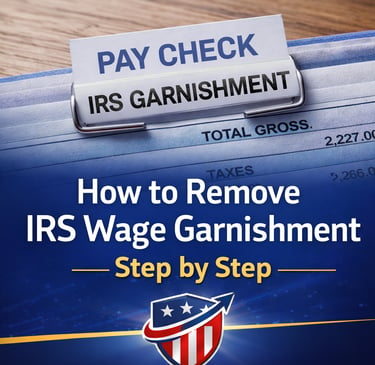
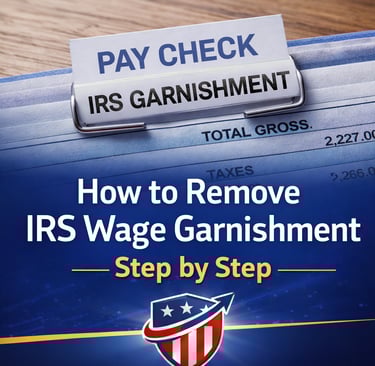
“How to Remove IRS Wage Garnishment – Step by Step”
It is designed to help you understand:
What actions actually stop garnishment
How timing affects outcomes
How to avoid costly missteps
How to regain financial breathing room without unnecessary escalation
The goal is not miracles. The goal is clarity, control, and minimizing damage while navigating a system that rarely explains itself.
If you decide to act, act informed.
continue
…For many readers, that realization comes only after damage has already occurred. What follows is a deeper, ground-level look at how IRS enforcement actually unfolds once garnishment or levy authority exists, how third parties behave when pulled into the process, and why certain “logical” reactions consistently make things worse instead of better.
How Employers Actually Handle IRS Wage Garnishments
Most taxpayers imagine that employers fight garnishments, delay them, or quietly ignore them. In practice, the opposite is true.
Employers Are Not on Your Side—And They Cannot Be
When an employer receives an IRS wage levy, it arrives as a formal legal document, not a casual request. It instructs payroll to withhold wages starting immediately and continuing indefinitely.
In many cases we see, employers comply faster than required because:
Failure to comply exposes them to liability
Payroll departments follow rigid checklists
There is no incentive to question the levy
Most taxpayers misunderstand this point: your employer cannot negotiate on your behalf, even if they sympathize with your situation.
Payroll Automation Makes Garnishment Ruthless
Modern payroll systems are automated. Once a wage levy is entered:
Withholding occurs automatically
There is no “manual discretion”
Corrections lag behind approvals
This means even if the IRS later agrees to release a garnishment, one or two additional paychecks may still be affected due to processing delays.
Employer Communication Often Increases Stress
Some employers notify employees immediately. Others do not. Some managers handle it discreetly; others escalate it to HR meetings.
One pattern that repeats across IRS enforcement actions is that workplace embarrassment becomes a secondary pressure tactic, even though it is not intentional.
This emotional pressure often pushes taxpayers to make rash financial decisions—borrowing at high interest, skipping rent, or cashing out retirement accounts prematurely.
How Banks Respond to IRS Levies in Practice
Banks behave very differently from employers, and misunderstanding this difference leads to repeated levies.
Banks Freeze First, Ask Questions Never
When a bank receives an IRS levy, it freezes the account immediately. There is no investigation into:
Where the money came from
Whether bills are due
Whether deposits are exempt
The bank’s role is purely mechanical.
The 21-Day Holding Period Is Misunderstood
Many taxpayers believe the 21-day hold is a grace period. It is not.
The hold exists to allow:
The IRS to cancel the levy if needed
The taxpayer to prove funds are exempt (rarely successful)
In practice, this often happens when the funds are already earmarked for survival expenses, yet still transferred after the holding period expires.
Repeat Levies Are Common
One pattern that repeats across IRS collection departments is this: bank levies recur when taxpayers move money instead of resolving authority.
Opening new accounts, shifting deposits, or using prepaid cards does not remove levy authority. It often increases scrutiny.
Why IRS Levies Escalate Faster Than People Expect
Many taxpayers assume the IRS moves slowly. That assumption is outdated.
Automation Accelerates Enforcement
Once levy authority exists, the IRS does not need further approvals to act. Internal systems can issue levies based on:
Account age
Balance thresholds
Prior nonresponse
Payment defaults
In practice, this often happens without warning beyond notices already sent months earlier.
Silence Is Interpreted as Refusal
The IRS does not interpret silence as confusion or fear. It interprets silence as unwillingness.
That interpretation matters because it determines whether enforcement escalates or pauses.
The Role of Timing Versus Paperwork
Most taxpayers overvalue paperwork and undervalue timing.
Correct Paperwork, Wrong Time = No Effect
Submitting forms after levy authority exists does not automatically stop enforcement.
We regularly see:
Installment agreements requested too late
Appeals filed after deadlines
Financial statements submitted after garnishment begins
At that point, paperwork may be acknowledged—but enforcement continues.
Imperfect Action at the Right Time Beats Perfect Action Too Late
One pattern that repeats across IRS enforcement actions is that early, imperfect engagement prevents later, perfect desperation.
Even incomplete agreements can temporarily halt enforcement if submitted before escalation thresholds are crossed.
IRS Departments Do Not Share Urgency the Same Way You Do
Understanding internal behavior matters.
Collections Is Goal-Oriented, Not Empathy-Oriented
The collections department operates on metrics:
Case resolution
Dollars collected
Enforcement actions completed
They do not track stress, hardship, or emotional toll unless it fits formal criteria.
Appeals Operates Under Different Rules—but Has Deadlines
Appeals can interrupt enforcement—but only if invoked properly and timely.
Most taxpayers misunderstand this point: missing an appeal window permanently changes leverage.
When Bankruptcy Is a Strategic Tool—and When It Is a Blunt Instrument
Bankruptcy can be lifesaving or deeply disappointing, depending on expectations.
Bankruptcy as a Pressure Release Valve
In many cases we see, bankruptcy is used to:
Stop active garnishment
Regain immediate cash flow
Create space to reorganize finances
This can be effective—but only if the taxpayer understands what happens after discharge.
Nondischargeable Tax Debt Creates False Hope
Many tax debts survive bankruptcy due to timing rules.
When that happens:
Garnishment can resume later
Interest continues to accrue
Enforcement authority reactivates
Bankruptcy delays pain—but does not always remove it.
Decision Paths That Actually Reduce Damage
At this stage, the question is no longer “what is possible in theory,” but “what reduces damage in reality.”
If Garnishment Has Not Started Yet
The focus should be on:
Interrupting levy authority
Choosing the least restrictive resolution
Preserving employer privacy
This is the highest-leverage phase.
If Garnishment Is Active
The focus shifts to:
Speed
Cash flow survival
Preventing compounding damage
Every paycheck matters.
If Both Garnishment and Levies Have Occurred
At this point, strategy becomes defensive:
Stopping future actions
Stabilizing income
Avoiding irreversible mistakes
Why Fighting the IRS Emotionally Almost Always Fails
Anger is understandable. It is also dangerous.
Arguments About Fairness Are Ignored
The IRS does not adjudicate fairness. It enforces statutes.
Threats and Ultimatums Accelerate Enforcement
Hostile communication often triggers faster escalation.
Calm, Procedural Action Works Better Than Passion
One pattern that repeats across IRS enforcement actions is this: the IRS responds to process, not emotion.
The Quiet Reality Most People Learn Too Late
By the time garnishment begins, the IRS has already decided enforcement is justified.
That does not mean all hope is lost—but it does mean the rules have changed.
The question is no longer “can I stop this easily?”
The question becomes “how do I stop this with the least permanent damage?”
Why Structure Matters More Than Strength
Most taxpayers believe they must fight harder. In reality, they must act more precisely.
Structure means:
Knowing which action stops which enforcement
Understanding timing thresholds
Avoiding actions that feel productive but do nothing
This is not about courage. It is about sequence.
A Final, Grounded Perspective
IRS wage garnishment is not personal. It is procedural. That does not make it less devastating—but it does make it predictable.
Predictability is power.
If you understand how enforcement unfolds, where it pauses, and where it accelerates, you regain something essential that garnishment takes away: agency.
If You Want a Clear Path Forward
If you are dealing with IRS wage garnishment—or are close to it—and want a structured, step-by-step framework that reflects how enforcement actually behaves in the real world, the guide:
“How to Remove IRS Wage Garnishment – Step by Step”
is designed to help you:
Identify which actions stop garnishment versus levies
Act within the windows that still matter
Avoid common, expensive mistakes
Preserve income and stability while resolving the situation
It does not promise miracles. It offers clarity, sequencing, and control—exactly what IRS enforcement is designed to strip away.
If you move forward, do so deliberately. The system rewards precision far more than panic.
https://removeirswagegarnishmentusa.com/remove-irs-wage-garnishment-step-by-step
Contact
Here to help you stop wage garnishments.
infoebookusa@aol.com
© 2026. All rights reserved.